IB Geography • Section 4
Ocean Management Futures
Future possibilities for managing the oceans as a global commons
Restored from the original AdornGeo Weebly page • syllabus order preserved
Increasing Demands for Abiotic Ocean Resources
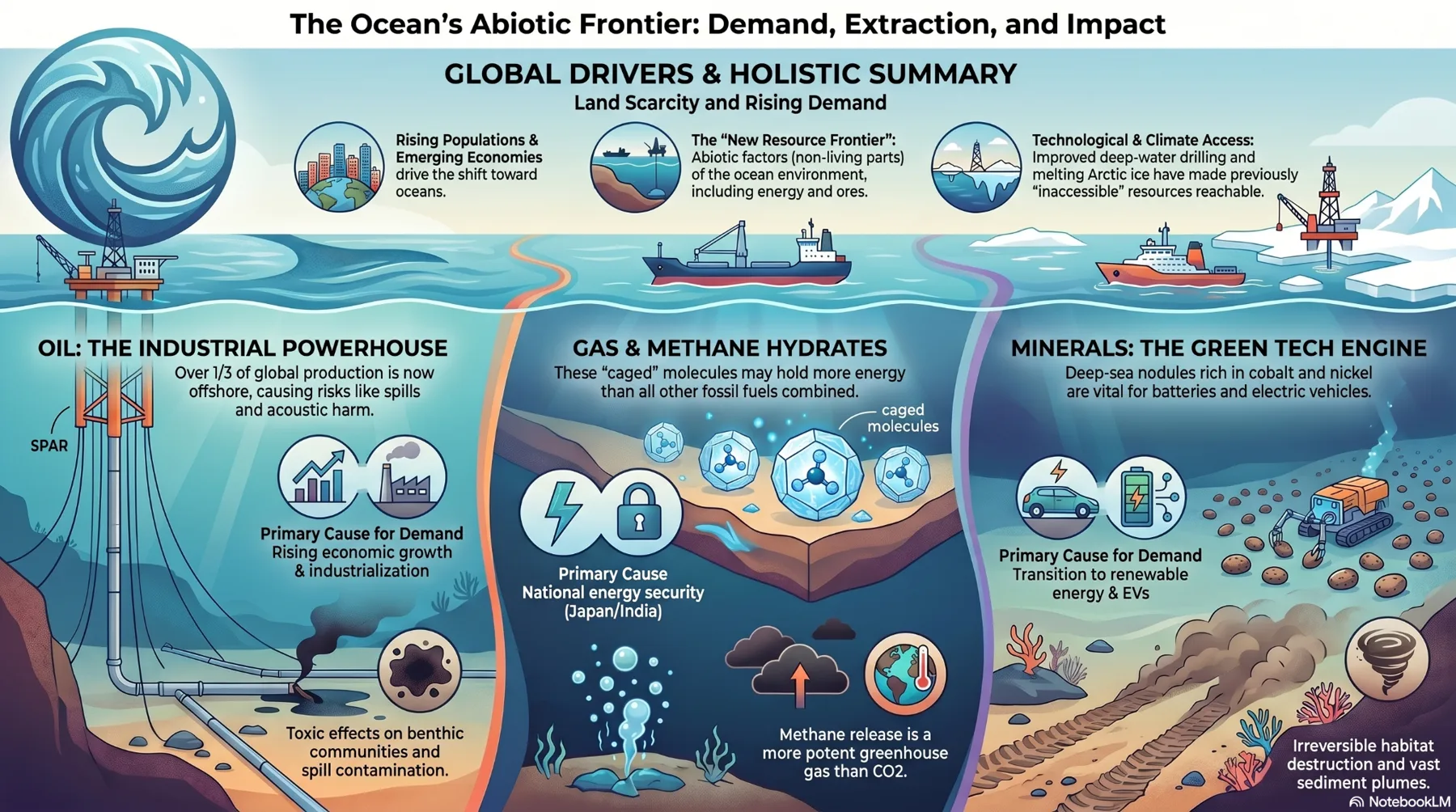
Causes and consequences of increasing demand for the abiotic resources of oceans, including minerals, oil and gas
Begin with the new Abiotic Ocean Frontier overview, then move through the three major deep-water resource frontiers in the new lesson: offshore oil, methane hydrates and deep-sea minerals. Students connect rising demand, land scarcity, technology and energy security to extraction, then compare the environmental consequences before deciding whether technical possibility should automatically become permission to extract.
- Distinguish abiotic resources from living ocean resources: oil, natural gas, methane hydrates, minerals, sand and renewable marine energy are non-living resources.
- Offshore oil extends resource supply but shifts risk into difficult-to-monitor marine environments; use Deepwater Horizon to make catastrophic spill risk concrete.
- Methane hydrates are a potential energy frontier, particularly where energy security matters, but methane leakage creates a powerful climate-risk feedback.
- Deep-sea mining is a useful futures debate: Clarion–Clipperton Zone nodules contain nickel, cobalt, copper and manganese, while mining may cause habitat removal, sediment plumes, noise and biodiversity loss in poorly understood ecosystems.
- Compare offshore oil, methane hydrates and deep-sea minerals: each becomes more accessible through technology, but each creates a different mix of economic, geopolitical and environmental consequences.
- Finish by comparing four choices: commercial extraction, strict international regulation, a precautionary pause or a moratorium.
Watch: Deep-Sea Gold Rush — abiotic ocean resources and the mining debate
Watch: Clarion–Clipperton Zone — the race to mine the bottom of the ocean
Watch: Deepwater Horizon — offshore oil risk
Deep-sea mining
Treat the deep seabed as a contested resource frontier. Students identify why states and companies want seabed minerals, then evaluate the uncertainty created by mining ecosystems that science is still documenting.
- Drivers: minerals for industry and energy technologies
- Potential gains: new mineral supply and strategic security
- Potential costs: habitat removal, sediment plumes, noise and uncertain ecosystem recovery
- Decision: precaution, moratorium, strict regulation or commercial extraction?
Trends in Biotic Resource Use
Trends in biotic resource use (fish and mammals) and the viability of alternatives to overfishing, including aquaculture, conservation areas and quotas
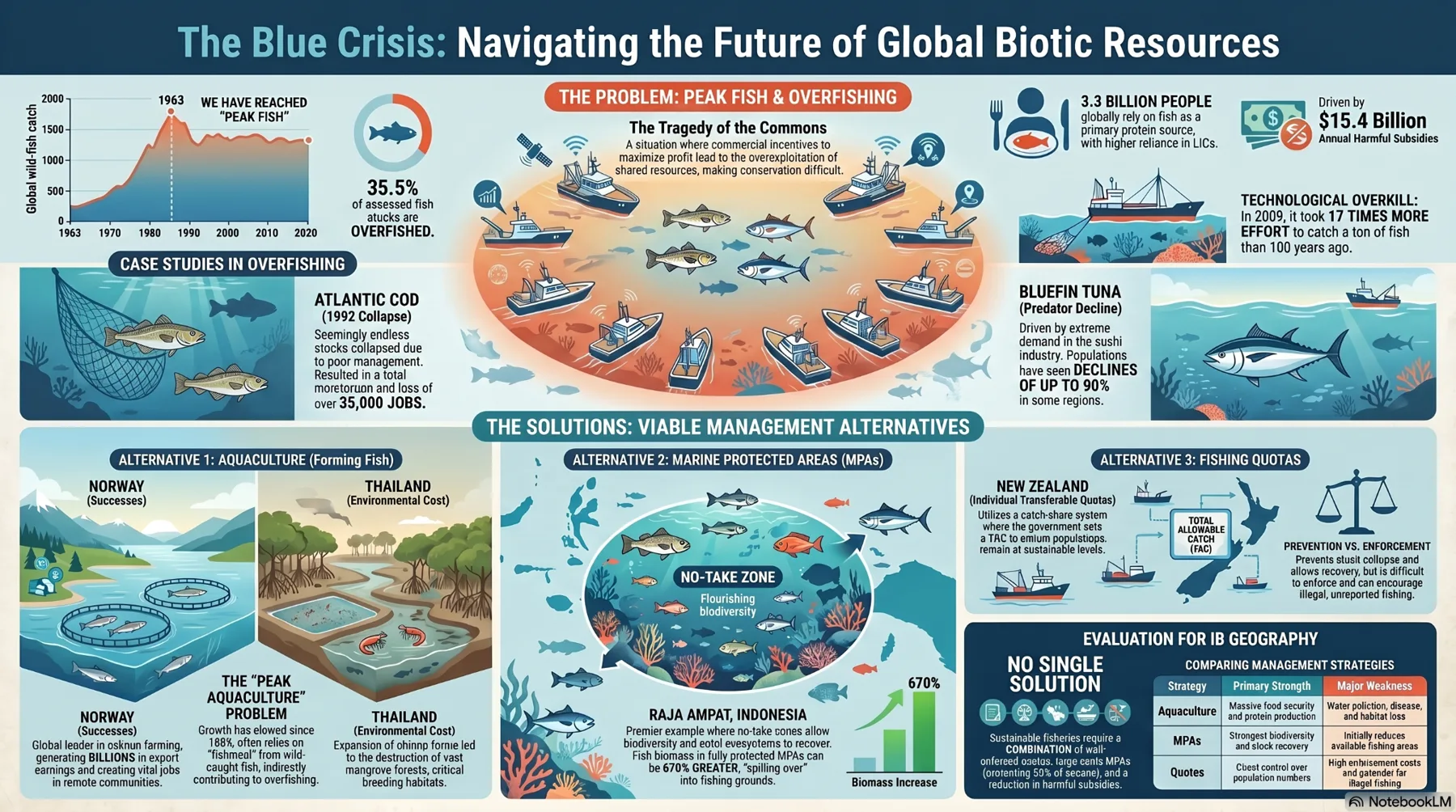
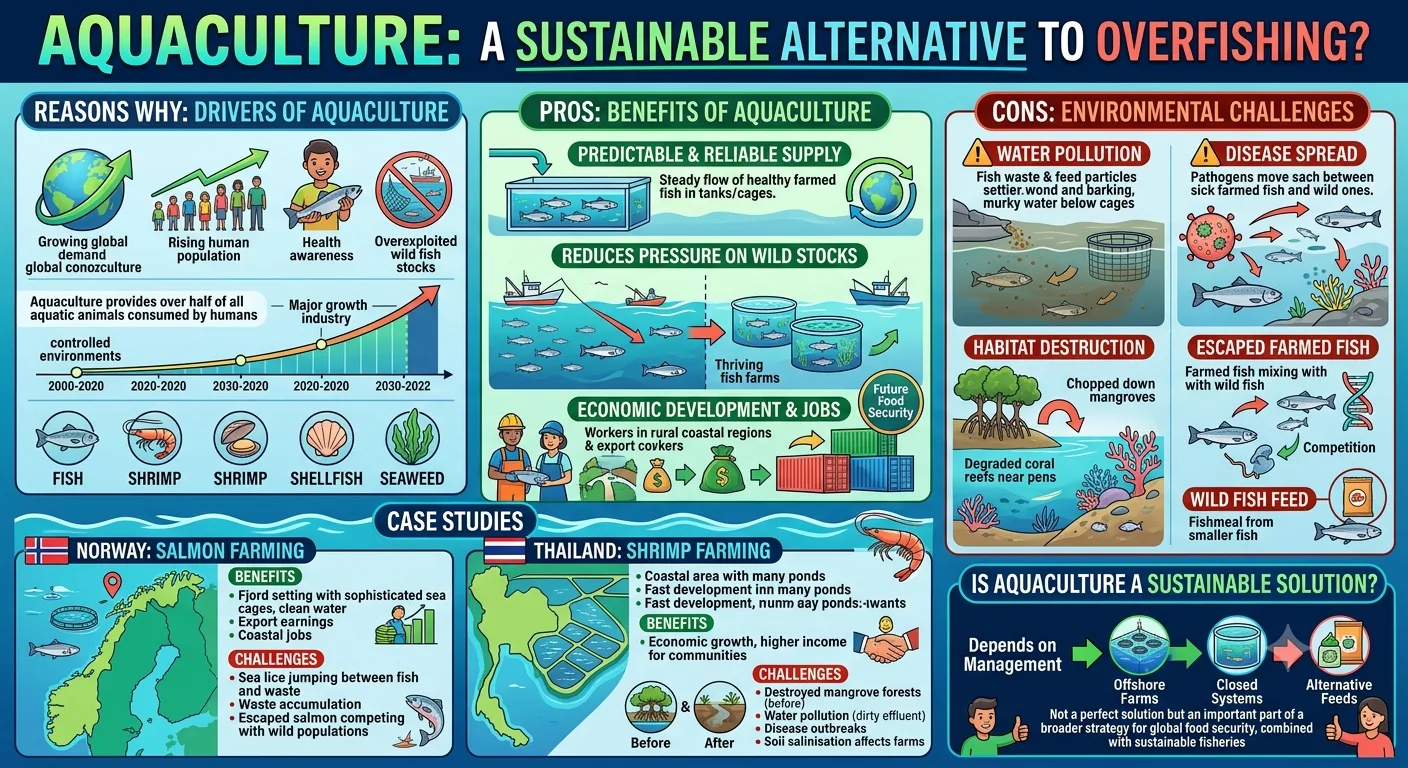
Start with the contemporary global picture: marine biotic resources support food security and livelihoods, but industrial fishing can remove stocks faster than they reproduce. Use the new overview infographic and video to establish the causes and consequences of overfishing, then compare aquaculture, marine protected areas and quotas as management responses. The aim is evaluation: no single strategy is sustainable in every place.
- Fish are renewable only when harvesting remains within the reproductive capacity of the stock.
- Industrial vessels use sonar, satellite navigation, refrigeration and highly efficient gear, linking distant fishing grounds to global markets and increasing pressure on stocks.
- Overfishing also damages wider ecosystems through bycatch, bottom trawling and disruption of marine food webs; slowly reproducing marine mammals are especially vulnerable to exploitation.
- Marine protected areas can protect breeding habitat and generate spillover into nearby fishing grounds, while quotas can control catch when stock data, monitoring and enforcement are strong.
- Aquaculture now supplies a major share of seafood and can reduce pressure on wild stocks, but its sustainability depends on feed sources, waste, disease control, escapes and habitat impacts.
- Use Newfoundland cod, bluefin tuna, Raja Ampat and New Zealand's quota system to compare why resource-use systems fail and what successful management requires.
Watch: Biotic resource use & overfishing — new lesson video
Ocean Pollution Management
Strengths and weaknesses of initiatives to manage ocean pollution, including local and global strategies for radioactive materials, oil and plastic waste
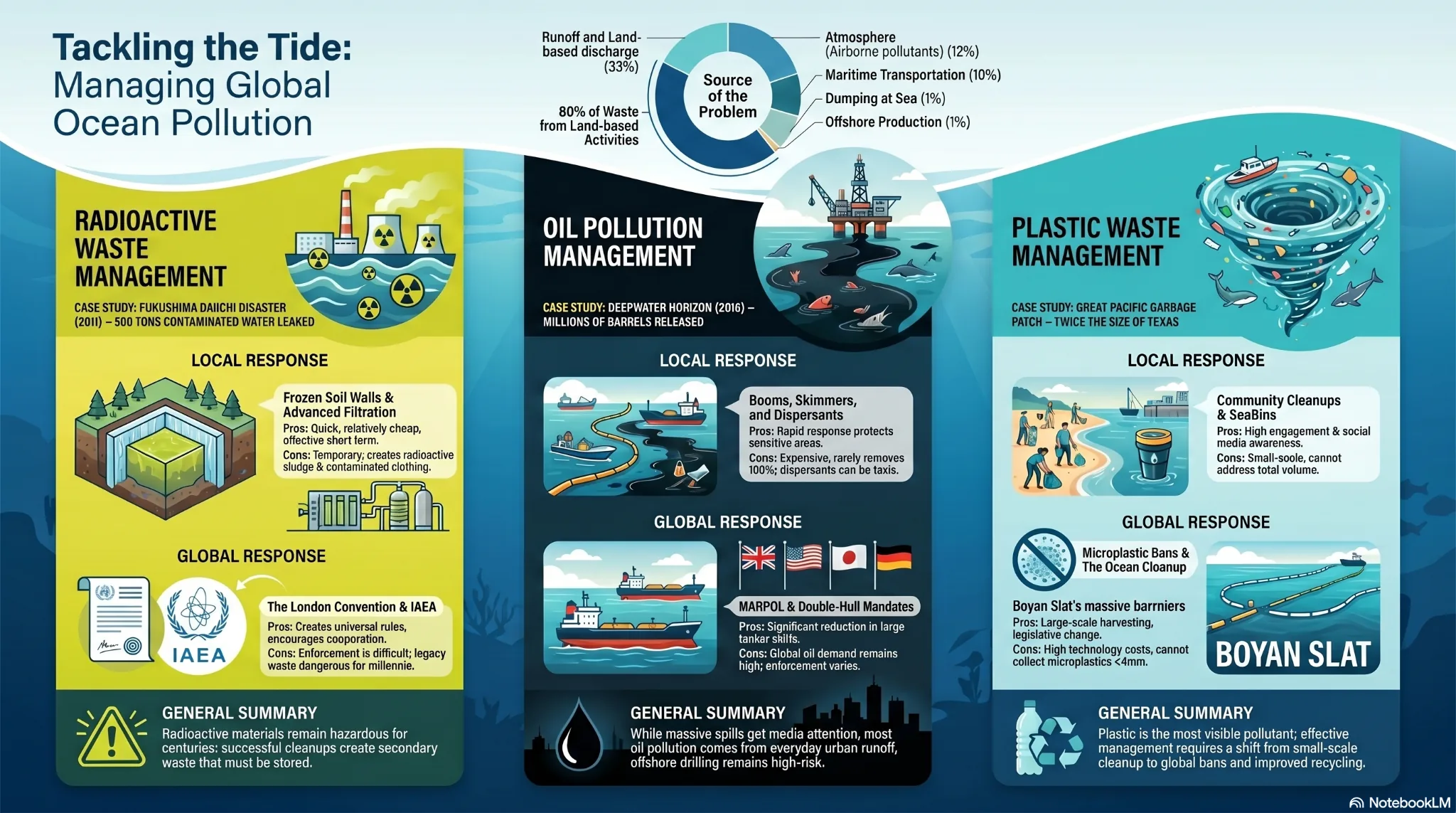
Use the new infographic, lesson video and Tides of Trash graphic novel to compare three very different pollutants — radioactive waste, oil and plastics. Students judge management strategies by scale, cost, effectiveness, side effects and whether they prevent pollution or merely clean it up afterwards.
- A large share of marine pollution originates on land, so effective ocean management often begins far upstream of the coast.
- Radioactive water at Fukushima illustrates containment, filtration, storage and the long time-scales of managing hazardous waste.
- Oil pollution requires prevention as well as spill response; tanker rules, safer ships and international standards can reduce risk, but drilling and shipping still create exposure.
- Plastic management ranges from beach clean-ups and Seabins to floating collection systems and bans on microbeads or single-use plastics.
- Evaluation matters: compare local versus global action and end-of-pipe clean-up versus reducing waste at source.
Watch: Managing Ocean Pollution — new lesson introduction
Watch: Marine pollution — original introduction
Watch: Ocean pollution — original lesson video
Watch: Ocean pollution management — original lesson video
Watch: Plastic waste response — original lesson video
Strategic Value of Oceans
The strategic value of oceans and sources of international conflict/insecurity, including contested ownership and control of islands, canals and transit choke points
Shift from resources to power with the new Oceans Flashpoints video, then use the two original mapping activities to locate the places that concentrate trade, energy flows and territorial claims. Students move from where each feature is, to why its geography gives it strategic value, and finally to how disruption or contested control can create insecurity far beyond the surrounding states.
- Begin with scale: oceans carry global flows, but sovereignty, territorial waters and Exclusive Economic Zones divide their management among states.
- Chokepoints concentrate shipping into narrow corridors. The Ever Given obstruction in the Suez Canal demonstrates how a local blockage can interrupt global supply chains.
- Compare the Suez and Panama canals with the Straits of Malacca, Hormuz and Gibraltar: canals are engineered shortcuts, while straits are naturally narrow passages with different bordering states and security risks.
- The Strait of Malacca links the Indian and Pacific oceans and is central to Asian trade; the Strait of Hormuz is especially significant for energy security because it connects the Persian Gulf to the open ocean.
- Small islands and reefs can extend maritime claims and provide sites for surveillance or military infrastructure, making apparently tiny places geopolitically important.
- Evaluation question: is a flashpoint important mainly because of the volume of flows passing through it, the resources it controls, its military value, or a combination of all three?
Watch: Oceans Flashpoints — chokepoints, EEZs and contested maritime space
Five strategic chokepoints
Use the original location activity to compare engineered canals and natural straits. For each place, students identify the flow being concentrated, who controls or borders the passage, what could disrupt it and why distant countries care.
- Suez and Panama canals — engineered shortcuts connecting major ocean basins
- Strait of Malacca — a narrow link between the Indian and Pacific oceans
- Strait of Hormuz — energy exports, regional tension and naval security
- Strait of Gibraltar — access between the Atlantic and Mediterranean
- Comparison — trade volume, energy dependence, alternatives and vulnerability to disruption
Quizlet: Option B4 — Ocean Management Futures
South China Sea Case Study
One contemporary geopolitical case study focusing on a contested ocean area
Use the South China Sea to bring the whole geopolitics section together: overlapping claims, reefs and artificial islands, fishing grounds, possible energy resources, freedom of navigation, military power and international law all occupy the same ocean space.
- Map the competing claims before discussing the conflict — the spatial pattern explains much of the tension.
- Connect EEZ claims and UNCLOS to access to fisheries, seabed resources and maritime control.
- Separate the interests of coastal claimant states from the wider strategic interests of major powers and global shipping.
- Evaluate why international law can clarify claims without automatically resolving power conflicts.
Watch: Who does the South China Sea belong to? — original case-study video
Ocean Management Futures: Synthesis
Future possibilities for managing the oceans as a global commons
Finish by asking the question behind the entire section: if ocean systems, resources, pollution and shipping routinely cross national borders, who should manage them? Students can now use evidence from mining, fishing, pollution and geopolitics to compare open access, national control, international regulation and cooperative stewardship.
- The oceans behave as connected systems, while political management is divided among states and jurisdictions.
- A global-commons approach requires cooperation, but states, firms, coastal communities and consumers do not share the same interests or power.
- Good management combines science, monitoring, enforceable rules, stakeholder participation and incentives that reduce pressure at source.
- Use the final judgement to connect all four Oceans sections: physical systems create opportunities and hazards, people value coasts and resources differently, and management choices create different futures.