IB Geography • Section 2.2
Consequences of Global Climate Change
The effects of global climate change on places, societies and environmental systems
Restored from the original AdornGeo Weebly page • syllabus order preserved
A Connected System of Consequences
The effects of global climate change on places, societies and environmental systems.
The original AdornGeo lesson begins with the climate system as a web of linked consequences. Students should trace how a physical change in the atmosphere can cascade through water, ecosystems, economies, health and migration rather than treating each impact in isolation.
- Climate impacts are interconnected: one change can trigger several environmental and social consequences.
- Risk is uneven because exposure, sensitivity and adaptive capacity vary between people and places.
- The timing and magnitude of impacts remain uncertain, but uncertainty does not mean that the risk is absent.
- Consequences can be harmful, beneficial or mixed, and they operate at local, national and global scales.
Build and test a climate domino chain
- Watch the new Cascade of Consequences introduction and list impacts under atmosphere, hydrosphere, biosphere and society.
- Use the Climate Domino visual to trace one pathway from an environmental shift through the water-energy-food nexus to a human outcome.
- Choose one initial change, such as higher temperature, and construct a chain of at least six linked consequences.
- Label every link as environmental, social, economic or political, allowing more than one label where appropriate.
- Identify one point where wealth, location, governance or adaptation could interrupt the cascade.
- Fact-check one numerical or geographical claim in the visual before using it as evidence.
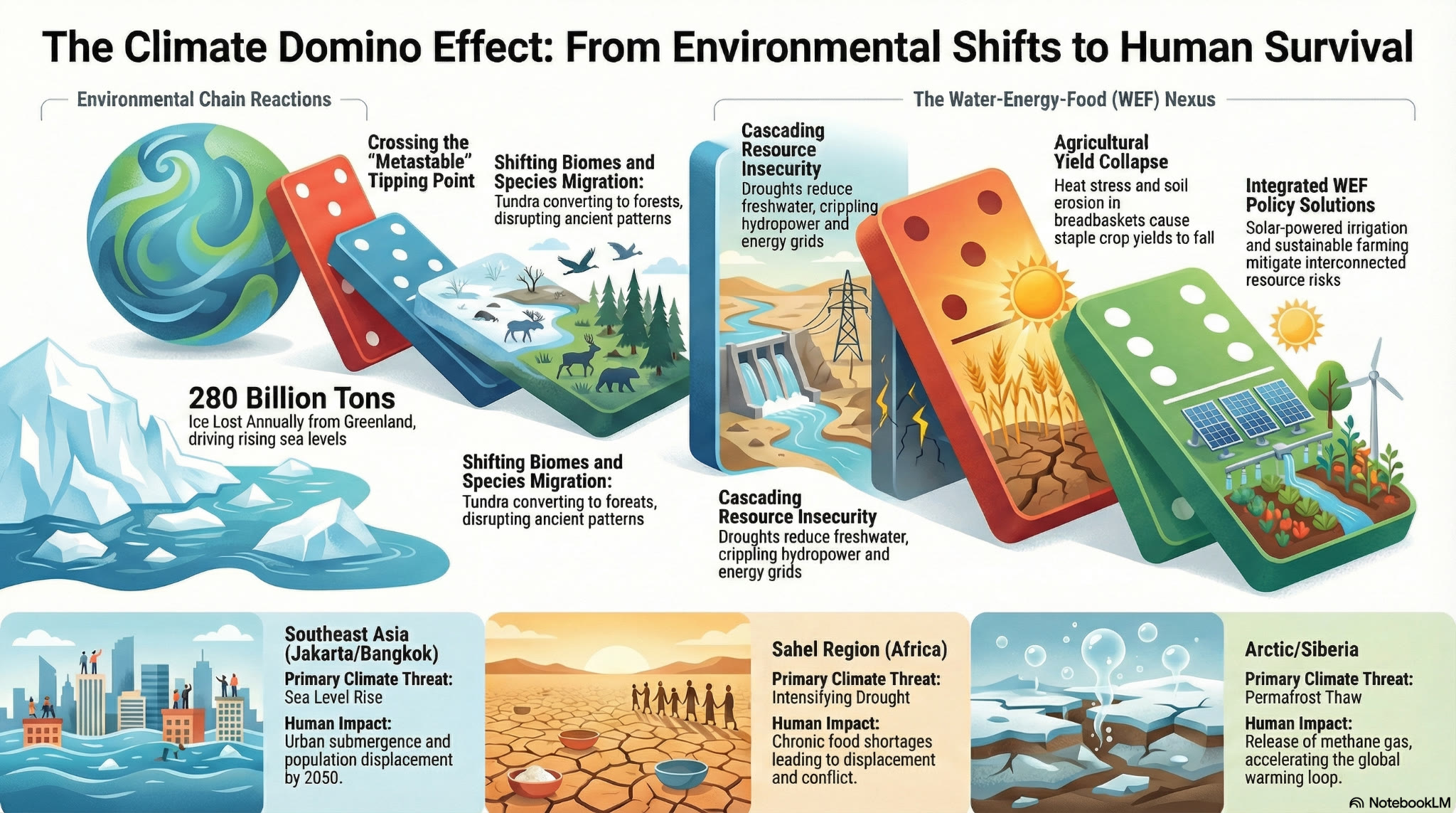


Watch: Cascade of Consequences — from physical change to human outcomes
Watch: WMO: State of the Global Climate
Watch: IPCC: Impacts, Adaptation and Vulnerability
Watch: The 11th Hour: environmental consequences
Watch: Carbon Map introduction
Water Stored in Ice and Oceans, and Changing Sea Levels
Climate change and the hydrosphere, atmosphere and biosphere, including water stored in ice and oceans, and changing sea levels.
This original sequence links warming to glacier and ice-sheet loss, thermal expansion, changing precipitation and sea-level rise. Students must distinguish floating sea ice from land ice and then locate the consequences for low-lying coasts.
- Sea level rises through both thermal expansion of warming seawater and the addition of water from melting land ice.
- Melting floating sea ice has little direct effect on sea level, while melting glaciers and ice sheets add water to the ocean.
- Changes in precipitation, evaporation, snowpack and glacier storage alter river discharge and seasonal water supply.
- A global mean does not create identical local outcomes because land movement, currents and gravitational effects vary spatially.
Read the rising-seas evidence
- Use the two original NASA videos to explain the two principal causes of contemporary sea-level rise.
- Explore the embedded Climate Central map for Bangkok at two warming scenarios and record which land uses are exposed.
- Draw a systems diagram linking ice loss, ocean warming, sea-level rise and one social consequence.
- Explain why a small vertical rise can produce a much larger horizontal change on a low-gradient coast.
Watch: NASA's simple explanation of sea-level rise
Watch: Antarctic ice loss and future sea-level rise
Watch: NASA: projected temperature and precipitation change
Carbon Stored in Ice, Oceans and the Biosphere
Climate change and the hydrosphere, atmosphere and biosphere, including carbon stored in ice, oceans and the biosphere.
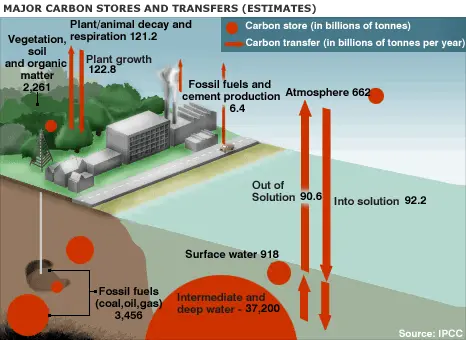
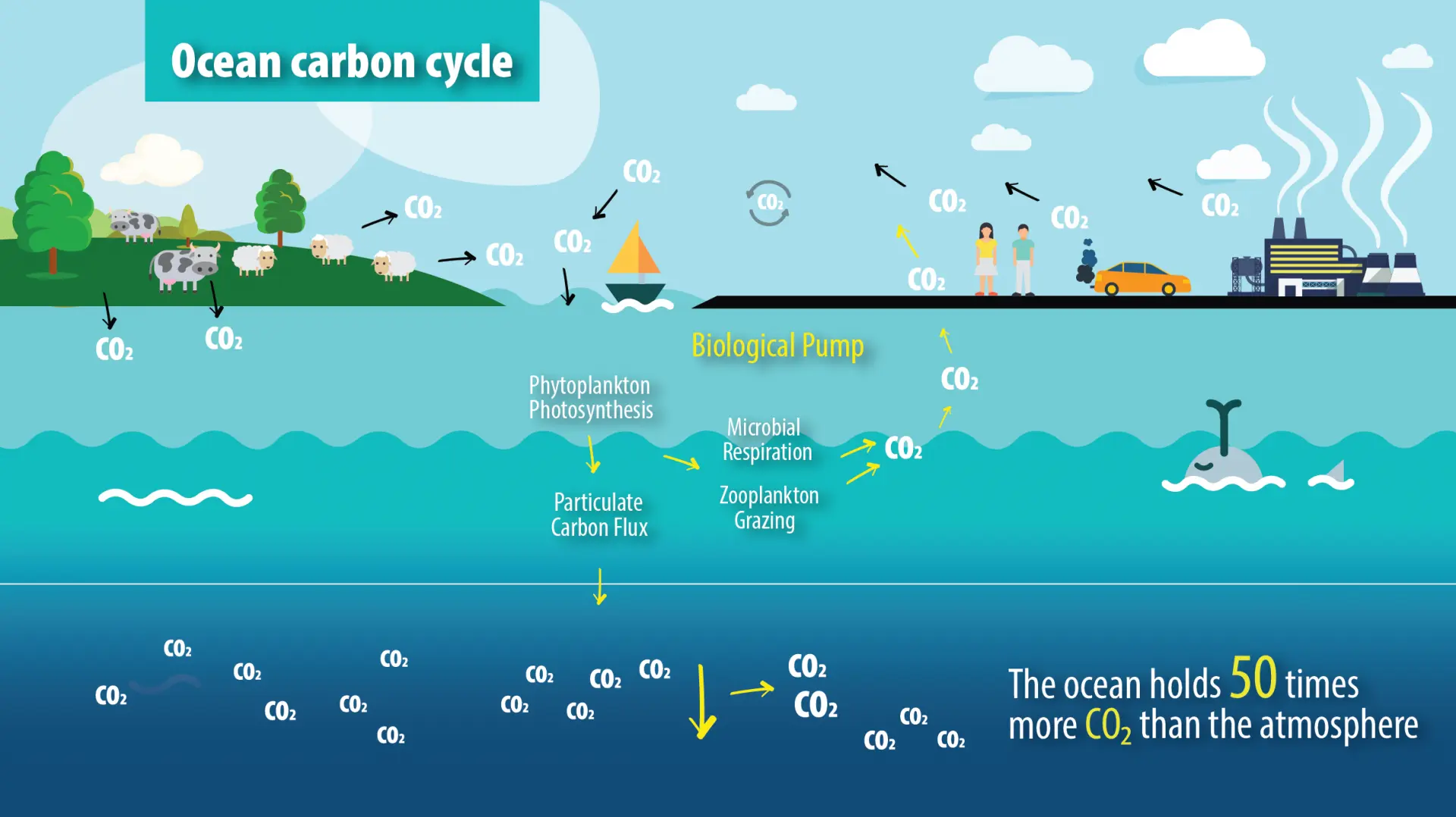
Carbon moves between the atmosphere, ocean, soils, vegetation and frozen ground. Warming can weaken natural sinks or turn stores into sources, creating feedbacks that intensify change.
- The ocean and terrestrial biosphere absorb a substantial share of human carbon emissions, slowing atmospheric accumulation.
- A warmer ocean holds less dissolved carbon dioxide and changing circulation can alter the movement of carbon to depth.
- Permafrost thaw and wildfire can release stored carbon, creating positive feedbacks.
- Ocean uptake of carbon dioxide causes acidification, which is chemically related to emissions rather than a consequence of warming alone.
Trace carbon through the system
- Draw five carbon stores and the main transfers between them.
- Add the effects of ocean warming, permafrost thaw, wildfire and vegetation change using a second colour.
- Identify which links are feedbacks and state whether each amplifies or reduces the original warming.
- Write an IB-style paragraph explaining why carbon stored outside the atmosphere still matters to future climate.
Extreme Weather Events, Including Drought
Climate change and the incidence and severity of extreme weather events, including drought.
A warmer climate changes the background conditions in which weather occurs. Students should avoid claiming that climate change simply causes every individual event; instead, use probability, intensity and attribution evidence.
- Warmer air can hold more water vapour, increasing the potential for intense rainfall.
- Higher temperatures increase evaporation and can intensify agricultural and ecological drought.
- Warmer oceans can provide more energy and moisture to tropical cyclones, although frequency and intensity must be treated separately.
- Attribution studies estimate how human-caused warming changes the likelihood or intensity of a particular event.
Attribute, do not overclaim
- Choose one recent drought, flood, heatwave or tropical cyclone from the Carbon Brief map.
- Record the event, location, observed impact and the attribution finding.
- Rewrite the inaccurate sentence 'climate change caused this disaster' as a precise geographical claim.
- Explain how exposure and vulnerability converted the physical event into a disaster.
Spatial Changes in Biomes, Habitats and Animal Migration
Climate change and the hydrosphere, atmosphere and biosphere, including spatial changes in biomes, habitats and animal migration patterns.
Species respond to changing temperature, rainfall, seasonality and disturbance by shifting range, changing timing or declining where suitable habitat disappears. The rate of climatic movement may exceed the ability of some species and ecosystems to adapt.
- Climate zones and ecological niches can move poleward or upslope as temperature patterns change.
- Range shifts are constrained by habitat fragmentation, mountains, coastlines and human land use.
- Changes in seasonal timing can create mismatches between flowering, insects, migration and breeding.
- Biomes can cross thresholds when drought, heat and fire interact, creating abrupt rather than gradual change.
Map a moving habitat
- Select one biome or migratory species and locate its present range.
- Predict the direction of change using temperature, rainfall and physical barriers.
- Explain one ecological and one human consequence of the shift.
- Evaluate whether protected areas with fixed boundaries remain effective under a changing climate.
Changes to Agriculture
Climate change and the hydrosphere, atmosphere and biosphere, including changes to crop yields, limits of cultivation and soil erosion.
Agricultural consequences are spatially uneven. Longer growing seasons and poleward cultivation may benefit some places, while heat stress, drought, flooding, pests and erosion reduce yields elsewhere.
- Yield depends on temperature, rainfall, soil moisture, extreme events, pests and farmers' capacity to adapt.
- Limits of cultivation may shift poleward or uphill, creating potential gains as well as losses.
- Intense rainfall and drought can both accelerate soil degradation and erosion.
- Food-system impacts extend beyond farms through prices, trade, nutrition and livelihoods.
Compare two agricultural futures
- Choose one higher-latitude and one tropical farming region.
- For each, classify possible changes as opportunity, risk or uncertain outcome.
- Include crop yield, cultivation limits, soil erosion and farmer adaptive capacity.
- Conclude why a global average can hide strongly contrasting local agricultural outcomes.
Impacts on People and Places
Impacts of climate change on people and places, including health hazards, migration and ocean transport routes.
The original AdornGeo page moves from physical change to lived experience. The four-degrees-warmer map helps students identify where impacts cluster, while the original articles foreground urban heat, inequality and systemic economic risk.
- Climate risk is produced by the interaction of hazard, exposure and vulnerability.
- The same physical change can create different outcomes in places with different wealth, infrastructure and governance.
- Cities amplify some risks through urban heat, impermeable surfaces and concentrated assets.
- Indirect impacts travel through financial systems, supply chains, food prices and insurance markets.
People, migration and trade: audit a synthesis visual
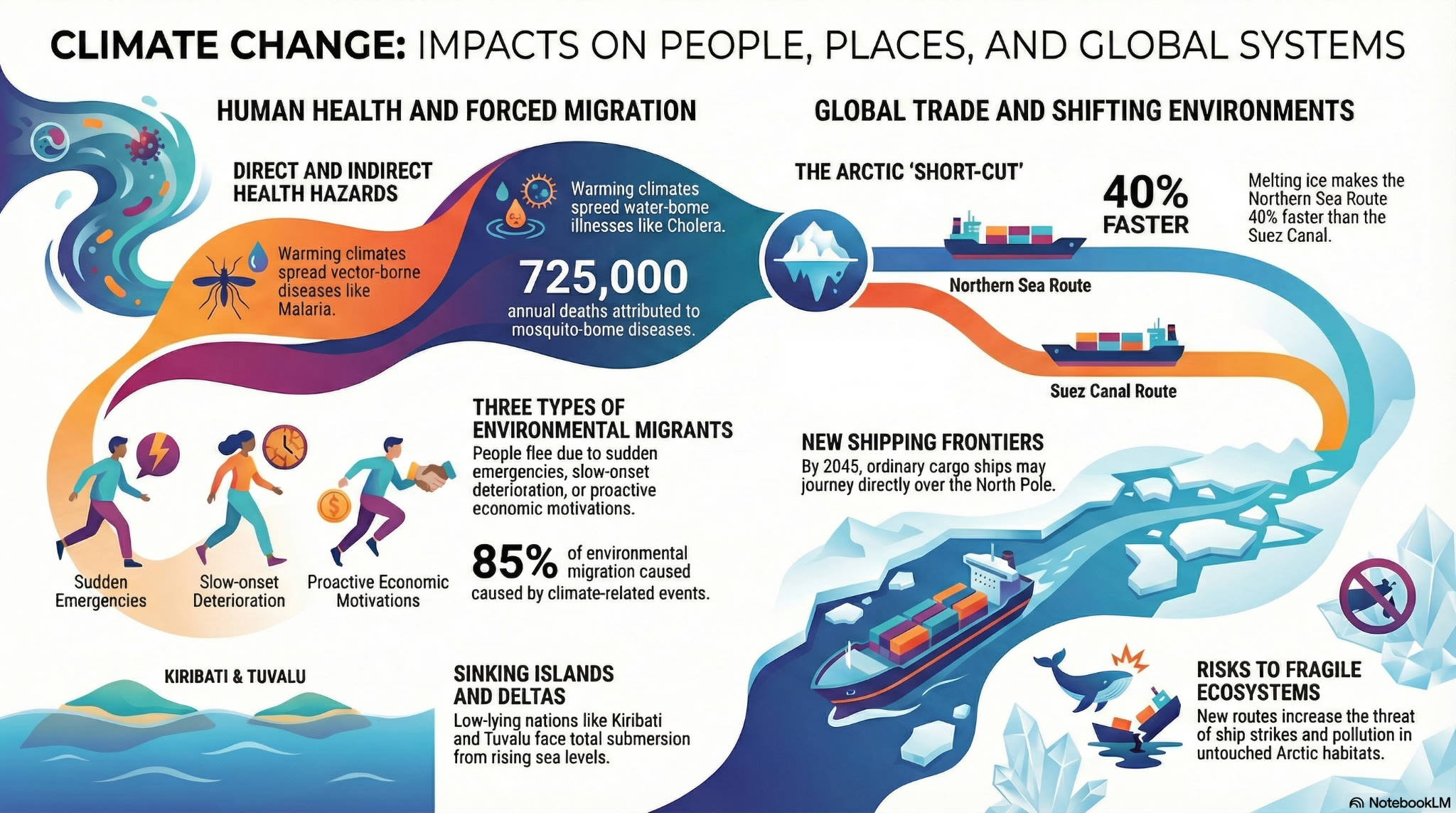
- Use the new summary infographic to identify one health pathway, one migration pathway and one changing-trade opportunity.
- For each pathway, separate the climate driver, exposure, vulnerability and final consequence.
- Verify two statistics or projections before quoting them, including the date and source used.
- Explain why an Arctic shipping opportunity can simultaneously create ecosystem, pollution and geopolitical risks.
Locate and explain uneven impacts
- Study the original four-degrees-warmer map and identify at least five contrasting geographical impacts.
- Choose two places exposed to a similar climate hazard but with different capacity to cope.
- Explain the difference using wealth, location, governance, infrastructure and social inequality.
- Write a reasoned response to: 'Climate change will primarily affect poorer societies.'

Watch: Climate change and the next financial crisis
Health Hazards
Impacts of climate change on people and places, including health hazards.
Health impacts may be direct, such as heat stress and injury, or indirect, through air quality, food and water insecurity, mental health and shifting disease vectors. The original El Niño example demonstrates how a climate anomaly can trigger outbreaks across several regions.
- Heatwaves raise mortality and illness, especially among older people, outdoor workers and those without cooling.
- Changing temperature and rainfall can alter the range and season of mosquitoes, ticks and water-borne disease.
- Drought, flood and crop failure affect nutrition, sanitation and mental health.
- Public-health outcomes depend on surveillance, housing, healthcare access and preparedness as well as climate exposure.
Create a climate-health pathway
- Use the original health-impact diagram to classify direct and indirect pathways.
- Watch the El Niño outbreak film and locate each health effect on a map.
- For one hazard, identify the most exposed group and the factor that makes it vulnerable.
- Design one prevention measure and one adaptation measure, then judge which actor should lead each response.

Watch: The crucial connection between climate change and health
Watch: How El Niño triggered disease outbreaks across the globe
Migration and the Kiribati Case Study
Impacts of climate change on people and places, including migration.
Climate rarely acts as a single cause of migration. It interacts with livelihoods, conflict, housing, land, family networks and government policy. The original Kiribati sequence examines sea-level rise, freshwater stress, identity, sovereignty and the idea of migration with dignity.
- Most climate-related movement is expected to occur within countries, although international movement may also increase.
- Migration can be temporary, permanent, voluntary, planned or forced.
- Slow-onset change can undermine habitability before land is permanently submerged.
- For small island states, relocation raises questions of culture, citizenship, sovereignty and maritime territory as well as housing.
From climate hazard to migration decision
- Use the first three original films to distinguish displacement, internal migration and human-rights impacts.
- Study the three Kiribati films and build a place profile covering physical exposure, social impacts, political choices and possible futures.
- Read the original migration-with-dignity resource and explain how it differs from an emergency evacuation strategy.
- Evaluate the statement: 'People displaced by climate change should be described as climate refugees.'

Watch: Climate Refugees trailer
Watch: Climate change could force millions to move internally
Watch: Mary Robinson: climate change and human rights
Kiribati: sea-level rise, habitability and migration with dignity
Kiribati's low-lying atolls make the country an important example of how sea-level rise, saltwater intrusion, coastal erosion and extreme events interact with livelihoods, identity and political sovereignty.
- Locate Kiribati in the central Pacific and describe the atoll landscape and concentration of population in South Tarawa.
- Trace how rising seas and storm surges affect freshwater lenses, housing, infrastructure, health and food production.
- Explain why loss of habitability can occur before complete inundation.
- Assess migration with dignity alongside local adaptation and international responsibility.
Watch: Kiribati might not be there much longer
Watch: Kiribati's president on combating climate change
Watch: Effects of climate change in Kiribati: quick facts
Watch: Feeling the effects of climate change
Watch: Inside Kiribati: the island being erased
Watch: Kiribati: a drowning paradise in the South Pacific
Ocean Transport Routes
Impacts of climate change on people and places, including ocean transport routes.
Retreating Arctic sea ice may lengthen the navigation season and reduce distances between some markets, while introducing environmental, geopolitical, insurance and infrastructure risks. This is a mixed consequence rather than a simple benefit.
- The Northern Sea Route and Northwest Passage can shorten some journeys between Atlantic and Pacific markets.
- Less sea ice does not remove navigational hazards, remoteness, limited rescue capacity or seasonal uncertainty.
- More shipping may increase emissions, pollution and disturbance in fragile Arctic ecosystems.
- Changing access raises questions about sovereignty, Indigenous communities, resources and control of strategic routes.
Evaluate an Arctic shipping future
- Map the Northwest Passage and Northern Sea Route and compare them with routes through Panama and Suez.
- Use the original reading to classify the impacts for shipping companies, Arctic states, Indigenous communities and ecosystems.
- Create a benefit-risk balance sheet with environmental, economic and political criteria.
- Reach a supported judgement on whether Arctic shipping is primarily an opportunity or a new source of risk.
Watch: Climate change will make the next financial crisis worse
Synthesis: Uneven Effects and Uncertain Futures
Synthesis, evaluation and skills: the uneven spatial distribution of effects and uncertainty about their timing, scale and impacts for individuals and societies.
Finish by bringing the environmental and human strands together. A strong IB response recognises uncertainty, but also evaluates the distribution of risk, the quality of evidence and the capacity of different societies to respond.
- Impacts are uneven between and within countries, and averages can conceal vulnerable groups and places.
- Uncertainty exists around emissions, climate sensitivity, local projections and future adaptation choices.
- Low-probability, high-impact outcomes deserve attention because consequences may be irreversible.
- Evaluation requires comparison of timescale, spatial scale, affected population and adaptive capacity.
Postcards from 2050: scenario or prediction?
- Read the seven Postcards from the Future and locate each place.
- For three postcards, separate evidence-based climate risk from imaginative scenario detail.
- Compare Bangkok, Kiribati and Bangladesh using exposure, vulnerability, adaptive capacity and climate justice.
- Rewrite one postcard as a more resilient 2050 future, identifying the decisions required between now and then.
IB synthesis and evaluation
- Create a matrix comparing hydrosphere, atmosphere, biosphere and human impacts across local, national and global scales.
- Add one named example to every row and identify who is most affected.
- Write a thesis for: 'The consequences of global climate change will primarily affect low-income countries.'
- Plan an evaluation of climate consequences on the biosphere, including uncertainty and counterclaims.