IB Geography • Section HL5.2
Changing Identities & Cultures
How global interactions bring cultural influences and changes to places
Restored from the original AdornGeo Weebly page • syllabus order preserved
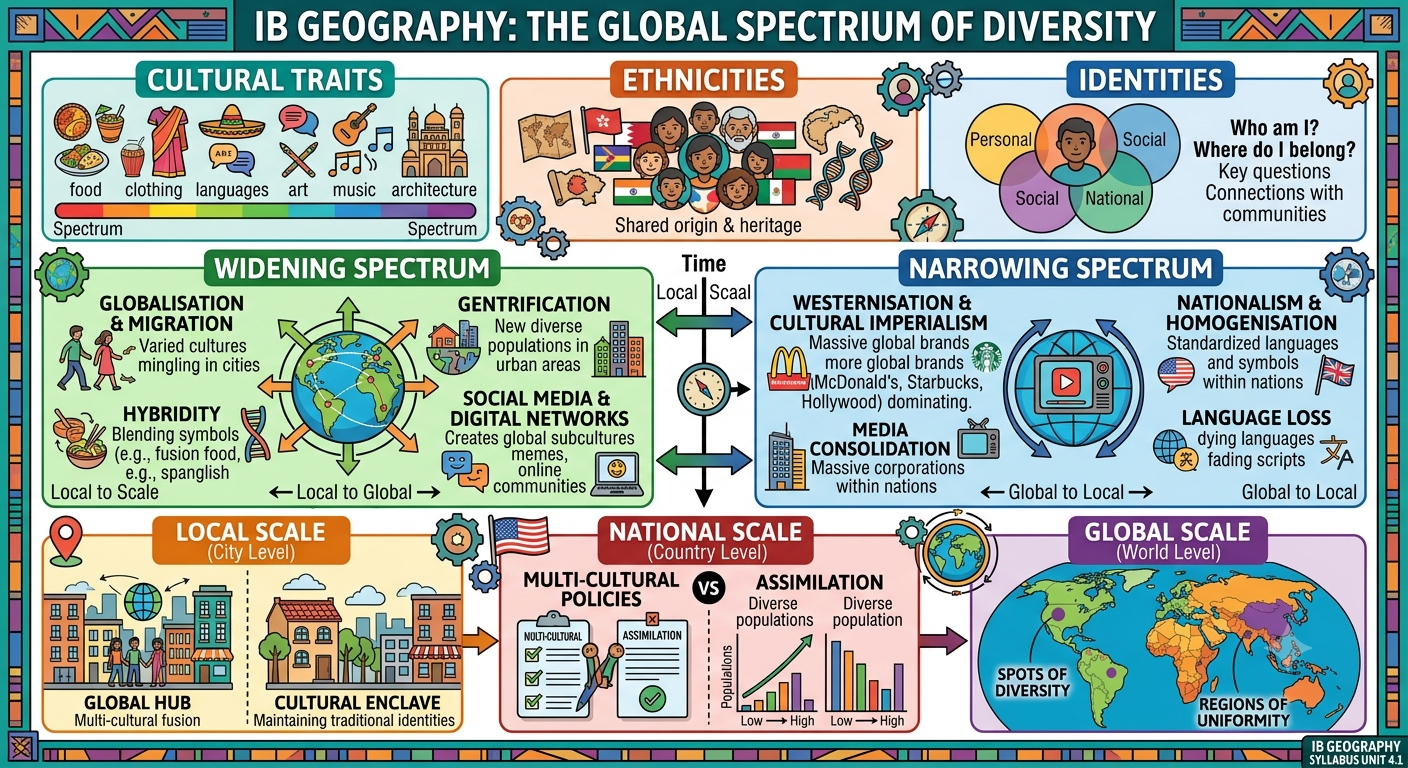
The Global Spectrum of Cultural Traits
The global spectrum of cultural traits, ethnicities and identities, and ways in which the spectrum of diversity is widening or narrowing at different scales.
Culture is not a single global trend. Language, religion, food, music, clothing, ethnicity and other identity markers can become more similar at one scale while becoming more distinctive at another. This opening section asks students to look for both convergence and continuing diversity, and to distinguish global patterns from what is happening in particular places.
- Cultural traits and identities operate at local, national and global scales.
- Global interaction can narrow some differences while creating or strengthening others.
- Patterns of cultural diversity need evidence rather than a simple claim that globalization makes everywhere the same.
Watch: Charting Culture — 2,600 years of cultural movement
Cultural Diffusion & Imperialism
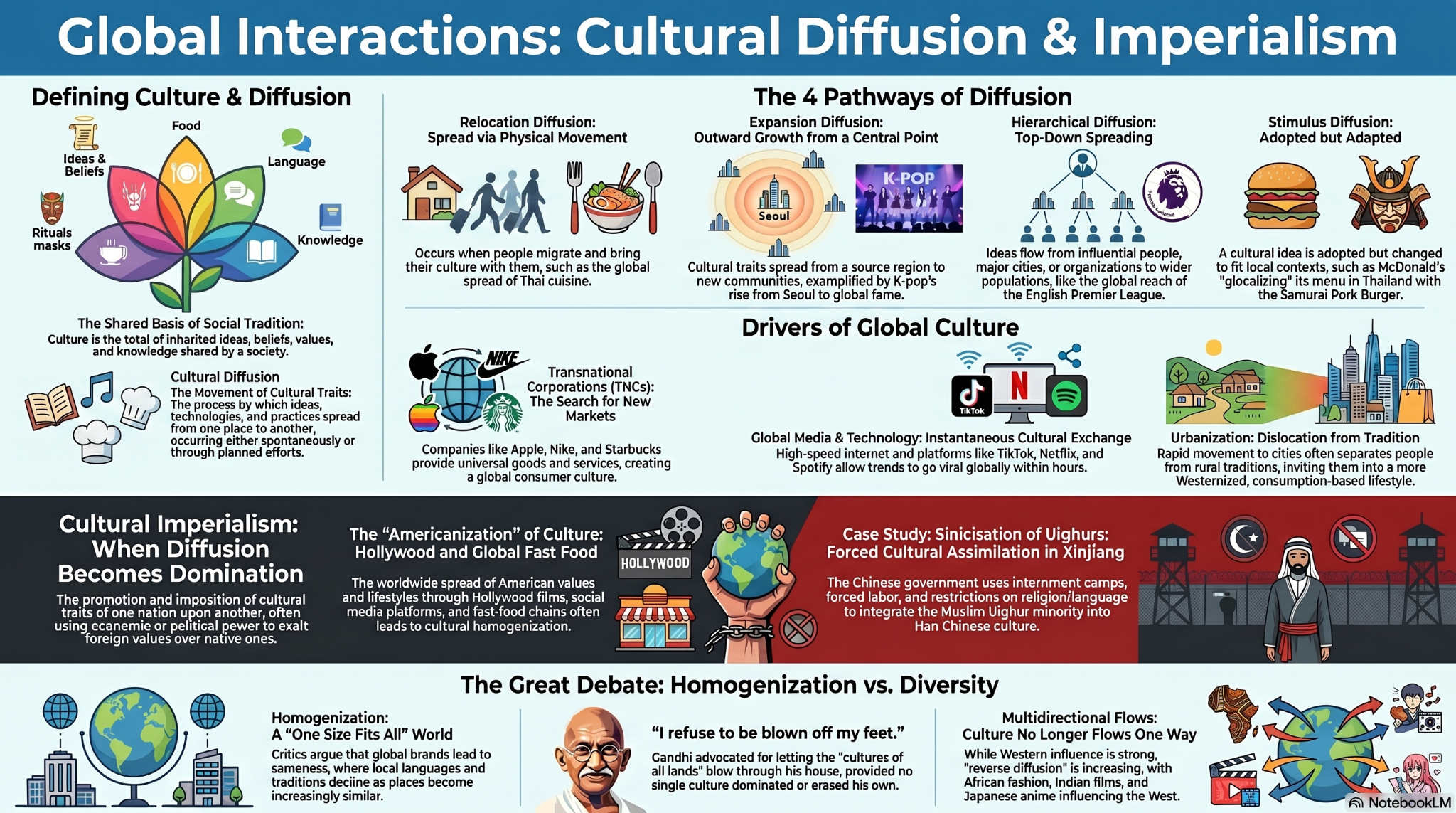
The effects of global interactions on cultural diversity in different places, including the diffusion of cultural traits and cultural imperialism.
This was one of the richest parts of the original AdornGeo page. Students move from the relatively neutral idea of diffusion to the more contested idea of cultural imperialism, then test those ideas through food, entertainment and the Uyghur/Xinjiang case. The point is to ask who has the power to spread culture, who adapts it, and when cultural influence becomes coercive.
- Diffusion describes how cultural traits spread between places through people, media, trade and networks.
- Cultural imperialism focuses on unequal power: one culture can dominate, displace or reshape another.
- Netflix, national broadcasters and global media provide accessible examples of changing cultural influence.
- The Xinjiang material provides a much sharper example of state power, identity and contested cultural change.
Watch: Global Cultural Interactions — Cultural Diffusion & Imperialism
Uyghur Identity, Sinicisation & Cultural Imperialism
Xinjiang provides a powerful case for examining when cultural influence becomes coercive. Uyghurs are a predominantly Muslim, Turkic-speaking ethnic group with a distinct cultural identity. Students can use this case to examine the relationship between state power, cultural homogenisation, security policy and the protection of minority identities.
- Identity and place: language, religion, ethnicity and connections with Central Asia are central to Uyghur identity.
- State power: examine reported restrictions on religious and cultural practices, surveillance, detention and policies of Sinicisation.
- Cultural imperialism: ask when promoting a dominant national culture becomes assimilation or coercive cultural change.
- Bangkok connection: use the 2015 Erawan Shrine bombing as relevant regional context when examining Uyghur tensions, migration and Thailand–China relations.
- Evidence and perspective: distinguish documented evidence, allegations, government explanations and the interpretations made by different media and rights organisations.
Watch: China's hidden camps — BBC News
Watch: Bangkok Erawan Shrine bombing — regional Uyghur context
Glocalization & Cultural Hybridity
The effects of global interactions on cultural diversity in different places, including glocalization of branded commodities and cultural hybridity.
Global culture is rarely copied unchanged. Products, food, music and ideas are reworked for local audiences, while local cultural forms can also be remixed for global ones. The original Tex-Mex and K-pop examples make this much easier to see than a definition alone.
- Glocalization is the adaptation of a global product or idea to fit a local place or culture.
- Cultural hybridity is the creation of new cultural forms by combining influences from different origins.
- Tex-Mex and K-pop are useful examples because students can identify both global and local ingredients in the same cultural product.
Watch: Cultural hybridity introduction
Changing Cultural Landscapes
The effects of global interactions on cultural diversity in different places, including cultural landscape changes in the built environment.
Cultural change is visible in places as well as in beliefs or media. The original page connected hip-hop diffusion to the homogenization of cities and then brought the issue home to Bangkok through development in Ari. Students can therefore move from an abstract global process to changes they can actually recognize in an urban landscape.
- Built environments can become more standardized as the same brands, architecture and development models spread.
- Cultural landscapes also show resistance and local reinterpretation rather than simple homogenization.
- Hip-hop offers a cultural diffusion example; San Francisco and Bangkok provide contrasting urban-landscape examples.
Global Diaspora
Case study of a global diaspora population and its culture(s), including how diasporas influence cultural diversity and identity at both global and local scales.
The original AdornGeo material used the Chinese diaspora as the detailed case study. Diaspora communities maintain connections across countries while also adapting to the places where they live, so they are a particularly strong way to connect migration, identity, cultural preservation and cultural change across scales.
- A diaspora is a dispersed population that maintains connections with a shared place of origin and with communities elsewhere.
- Diaspora networks can preserve language, food, religion, festivals and other cultural traits across generations.
- Diaspora cultures also change through interaction with host societies, producing multiple and sometimes hybrid identities.
- Students should be able to explain influence in both directions: how a diaspora changes a host place and how the host place changes diaspora identity.