IB Geography • Section 3
Resource Stewardship
Possibilities for managing resources sustainably and power over the decision-making process
Restored from the original AdornGeo Weebly page • syllabus order preserved
One Planet, Divergent Futures
Divergent thinking about population and resource consumption trends: pessimistic views, including neo-Malthusian views; optimistic views, including Boserup; balanced views, including resource stewardship.
Begin by stepping back. The Pale Blue Dot animation frames Earth as a shared, finite home; the new reading then turns that emotional perspective into a geographical argument. Malthus saw population growing faster than food supply; Boserup argued that pressure stimulates innovation; stewardship seeks a route that accepts ecological limits without treating collapse as inevitable.
- Malthus: population can grow geometrically while food supply grows arithmetically, creating the risk of positive checks such as famine, disease and conflict.
- Boserup: need can stimulate innovation, agricultural intensification and more productive resource use, although population pressure is not the only cause of technological change.
- Neo-Malthusian thinking: the 1972 Limits to Growth model connected population, food, industrial output, finite resources and pollution as one global system.
- Balanced stewardship: carrying capacity changes with consumption, inequality, technology, governance and environmental management, so it is neither a fixed number nor a purely technical problem.
Three perspectives evidence table
- After the Pale Blue Dot film, write one sentence answering: what do humans own, and what do humans owe future generations?
- Read the new four-page resource and create three columns: pessimistic, optimistic and balanced stewardship.
- For each perspective, record its central claim, two pieces of evidence, one assumption, a likely policy response and one criticism.
- Place the Sahel, Green Revolution, renewable-energy transition and Costa Rica examples on a continuum from limits to ingenuity.
- Finish with a justified answer: which perspective best explains population and resource consumption today?
Watch: Pale Blue Dot — perspective, responsibility and stewardship
Watch: Population, sustainability and resources — the original AdornGeo introduction
Resource Stewardship & Power Over Decisions
Possibilities for managing resources sustainably and power over the decision-making process.
Stewardship is the responsible planning, use and safeguarding of resources for others, including future generations. It is also political: households, firms, governments and international organisations have very different capacities to decide what is extracted, consumed, conserved, recycled or discarded.
- Scale matters: action by individuals may reduce demand, but governments and firms shape infrastructure, product design, prices and regulation.
- Power matters: the people who gain from extraction or consumption are not always the people who bear pollution, scarcity or waste.
- Time matters: stewardship weighs immediate livelihoods and development against long-term resource security and intergenerational equity.
Power map
- Choose one resource issue from the previous page: food, water, energy, waste or e-waste.
- Map the decision-makers at household, local, national, corporate and international scales.
- Use arrows to show who controls finance, regulation, information and access to the resource.
- Identify whose voice is weakest, then propose one change that would make stewardship more equitable.
From Linear to Circular to Doughnut
The value of the circular economy as a systems approach for effective cycling of materials and energy.
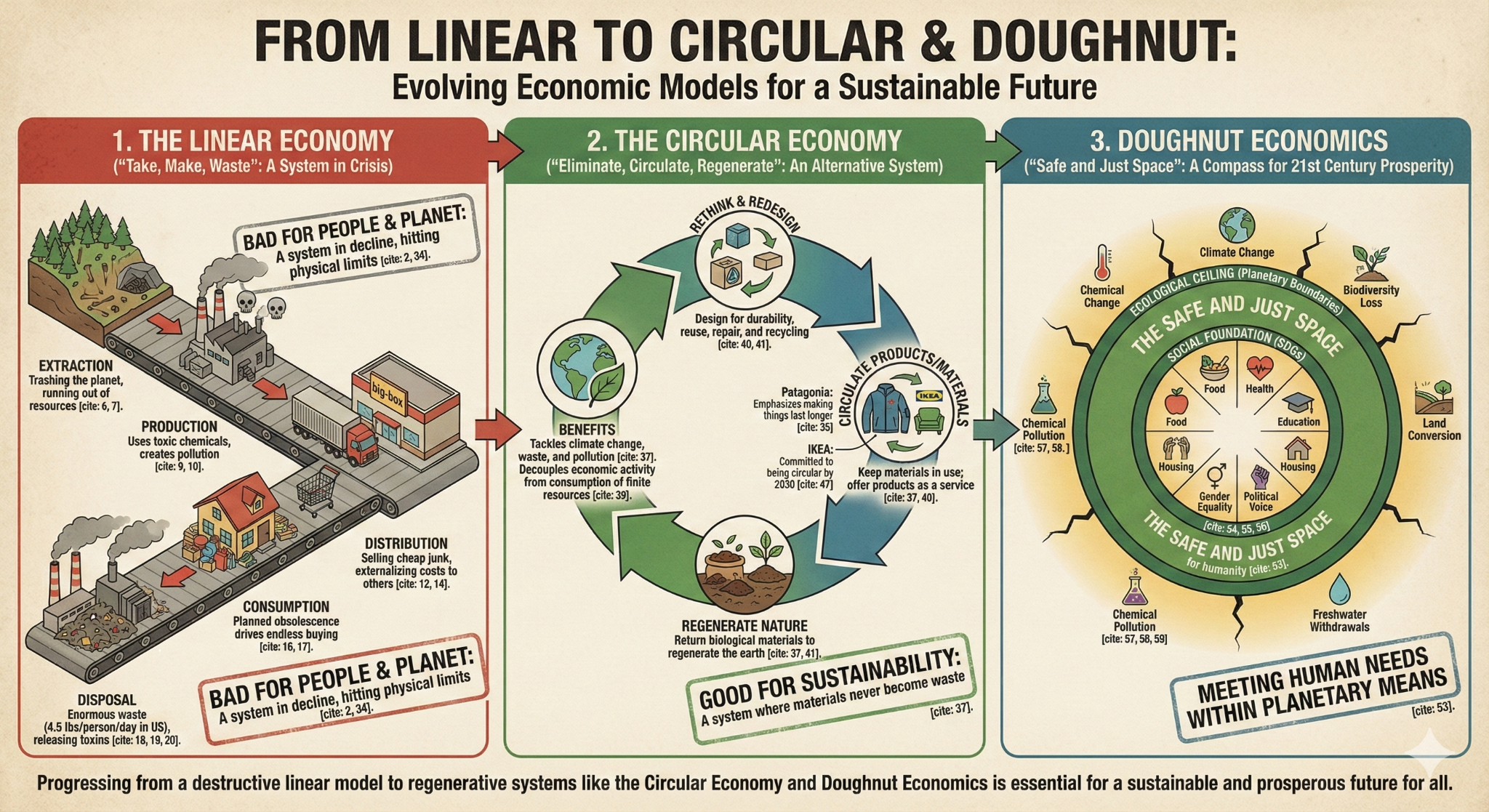
The uploaded infographic puts three economic models into one visual argument. A linear economy extracts, makes and discards. A circular economy redesigns flows so materials remain in use and living systems regenerate. Doughnut Economics adds a second test: can societies meet essential human needs without crossing ecological ceilings? The models overlap, but they answer different questions.
- Design out waste and pollution before production begins, rather than relying only on end-of-pipe recycling.
- Keep products and materials in use through durability, repair, sharing, resale, remanufacture and product-as-a-service models.
- Separate technical cycles, in which manufactured materials circulate, from biological cycles, in which safe nutrients return to living systems.
- Doughnut Economics combines a social foundation with an ecological ceiling, making equity and wellbeing part of resource stewardship rather than optional extras.
- Judge every model at system scale: rebound effects, energy inputs, transport, unequal access and continued growth can reduce the gains from better material cycling.
Model comparison and product redesign
- Annotate the infographic: use one colour for material flows, another for environmental limits and a third for human wellbeing.
- Explain one strength and one limitation of each model. Do not assume the right-hand model simply replaces everything before it.
- Choose a phone, item of clothing, bicycle, food product or piece of furniture and draw its existing linear chain from extraction to disposal.
- Redesign it using circular principles, then test whether the redesign also fits inside the doughnut's social foundation and ecological ceiling.
- Identify the actor with the greatest power to make your redesign happen and one actor likely to resist it.
Watch: What is the circular economy? — Ellen MacArthur Foundation
Circular Economy Case Studies at Contrasting Scales
Different perspectives on global resource use and the likely effectiveness of management actions at varying scales.
The recovered AdornGeo page finished the circular-economy lesson by comparing action at different scales. Use these cases to move beyond description: identify the material loop, the decision-maker, the spatial scale, the benefits, and what still leaks out of the system.
IB comparison: management at differing scales
- Choose two cases operating at different scales.
- For each, explain how materials or energy are cycled and identify who holds decision-making power.
- Use evidence to compare environmental, economic and social benefits.
- Conclude which scale is likely to be more effective and explain the limits of that judgement.
IKEA: take-back, resale and circular design
Furniture take-back and resale can extend product life and reduce demand for new materials. IKEA also illustrates the power of a large firm to redesign products, procurement and reverse logistics across a global supply chain.
- Map the forward and reverse flows of furniture and materials.
- Distinguish reuse from recycling: which retains more embedded energy and value?
- Evaluate access, transport emissions and whether continued sales growth is compatible with circularity.
China and Japan: scaling circular systems
National circular-economy strategies can coordinate standards, industrial parks, waste systems and producer responsibility. Their larger scale offers greater potential, but also makes implementation, monitoring and uneven regional outcomes central to evaluation.
- Compare national regulation with voluntary company action.
- Look for industrial symbiosis: can one firm's waste become another firm's input?
- Evaluate how success should be measured: recycling rate, lower material footprint, lower emissions, or improved wellbeing.
Wongpanit: turning waste into a resource
Thailand's Wongpanit recycling network is a locally relevant example of waste recovery as a business. It helps students examine collection, sorting, informal and formal labour, commodity prices and the limits of recycling when products were not designed for recovery.
- Trace the flow of one recoverable material from Bangkok household to secondary raw material.
- Explain how market value changes whether waste is collected.
- Decide whether recycling alone qualifies as a circular economy.
The UN Sustainable Development Goals: Role & Progress
The role of the UN Sustainable Development Goals and progress made toward meeting them.
The SDGs connect stewardship to global targets, national policy, company reporting and local action. Goal 12 is central, but resource stewardship also links directly to Goals 2, 6, 7, 11, 13, 14 and 15. The key distinction is between adopting policies and achieving measurable changes in material use, waste and environmental pressure.
- The SDGs create shared language, targets and indicators, but implementation remains voluntary and progress is uneven.
- Goal 12 asks societies to decouple development from resource depletion through sustainable production, consumption, procurement and waste management.
- The latest UN evidence shows the implementation gap clearly: food waste and e-waste remain extremely high even as more governments and companies adopt sustainability policies and reporting.
- Evaluate progress geographically: global averages conceal differences in consumption, capacity, responsibility and data quality between countries.
Goal 12 progress audit
- Select three Goal 12 targets and record the indicator used to measure each one.
- For every target, identify evidence of progress and evidence that the world remains off track.
- Explain which actors hold the power to accelerate progress: consumers, cities, national governments, firms or international organisations.
- Write a short judgement on whether the SDGs are changing resource use or mainly improving commitments and reporting.
Watch: The Sustainable Development Goals — original AdornGeo introduction
Stewardship Decision Lab: Who Should Act?
Different perspectives on global resource use and the likely effectiveness of management actions at varying scales.
Resource stewardship is not a single solution. It is a decision about limits, responsibilities, power, evidence and scale. This final enquiry asks students to combine the whole unit rather than repeat isolated case-study facts.
- Effective stewardship usually combines demand reduction, better design, regulation, investment, monitoring and changes in social norms.
- Actions should be judged through environmental effectiveness, equity, feasibility, speed, spatial scale and the risk of shifting impacts elsewhere.
- A convincing geographical judgement explains why the best response may vary between places and scales.
Resource summit and exam synthesis
- Choose one challenge: fast fashion, smartphones, food waste, freshwater scarcity or fossil-fuel dependence.
- Assign stakeholder roles: producer, consumer, local community, national government, environmental NGO and future generation.
- Each stakeholder proposes one action and defends it using one theory, one stewardship model and one named example from this page.
- Rank the proposals using five criteria: impact, equity, feasibility, speed and scale. Record who gains, who pays and who decides.
- Individually answer: Evaluate the likely effectiveness of resource stewardship strategies at differing scales [10]. Include a counterargument and a reasoned final judgement.