IB Geography • Section 2
Impacts of Changing Trends in Resource Consumption
How changing consumption creates interconnected pressures on water, food, energy and waste systems
Restored from the original AdornGeo Weebly page • syllabus order preserved
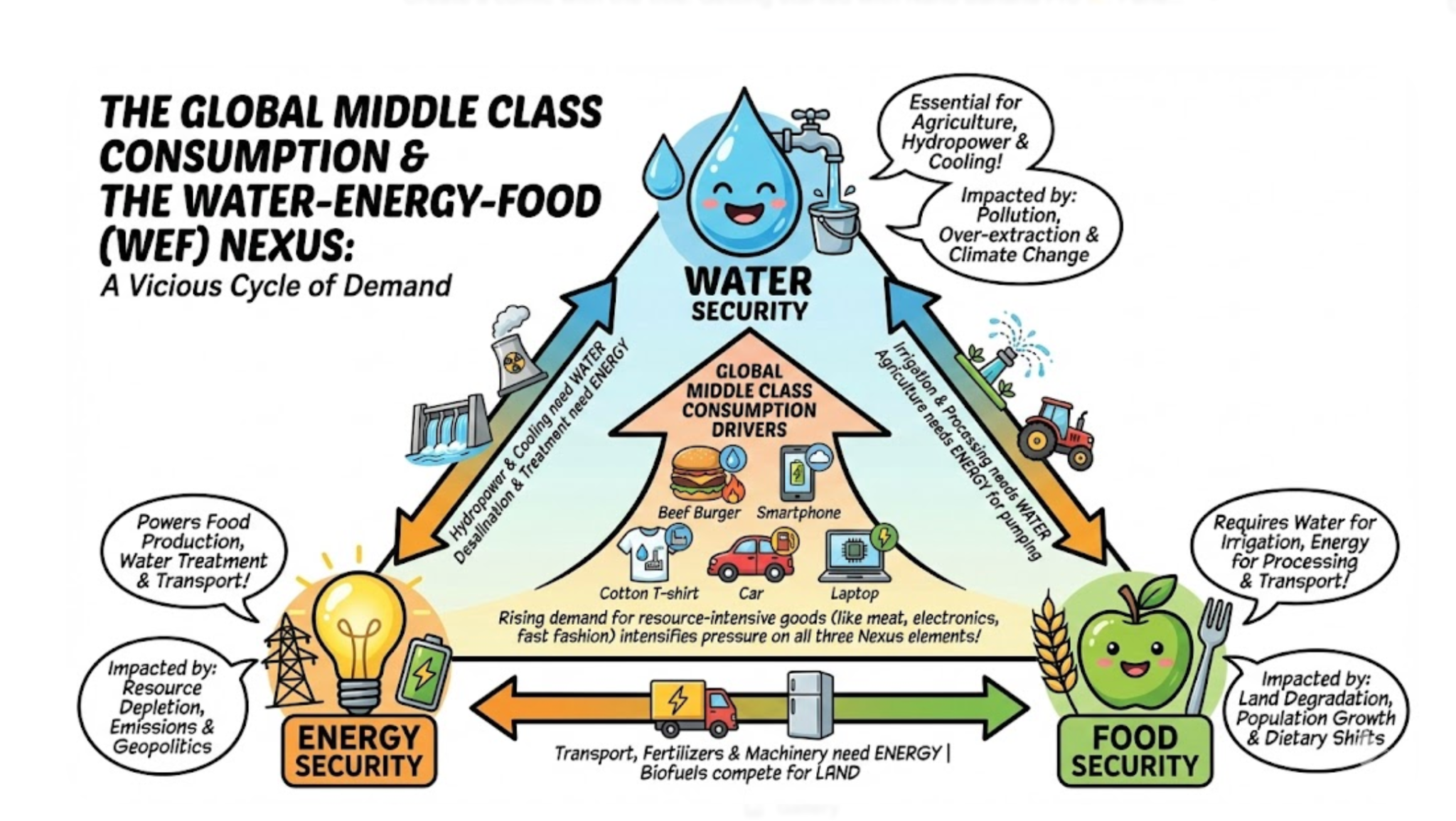
Start Here: Resource Security Is a Connected System
How pressure on resources affects the future security of places, including the interconnections between water, food and energy.
Resource security is not three separate stories. Water grows food and generates energy; energy pumps, treats and moves water and food; food systems compete for land, water and energy. Rising middle-class consumption increases these linked demands, so a solution in one sector can create insecurity in another.
- Security combines availability, access, affordability, quality and reliability.
- A change in any nexus component can cascade through the other two.
- National abundance can conceal regional scarcity, unequal access and vulnerable groups.
Nexus annotation challenge
- Choose one central driver: a beef burger, smartphone, cotton T-shirt, car or laptop.
- Trace a direct pressure on water, food and energy, adding a named place where each matters.
- Draw a feedback loop with at least four links. Label arrows with active verbs such as increases, reduces or competes for.
- Explain in 60 words why managing only one resource could produce an unintended consequence.
Watch: Introducing the water–food–energy–climate nexus
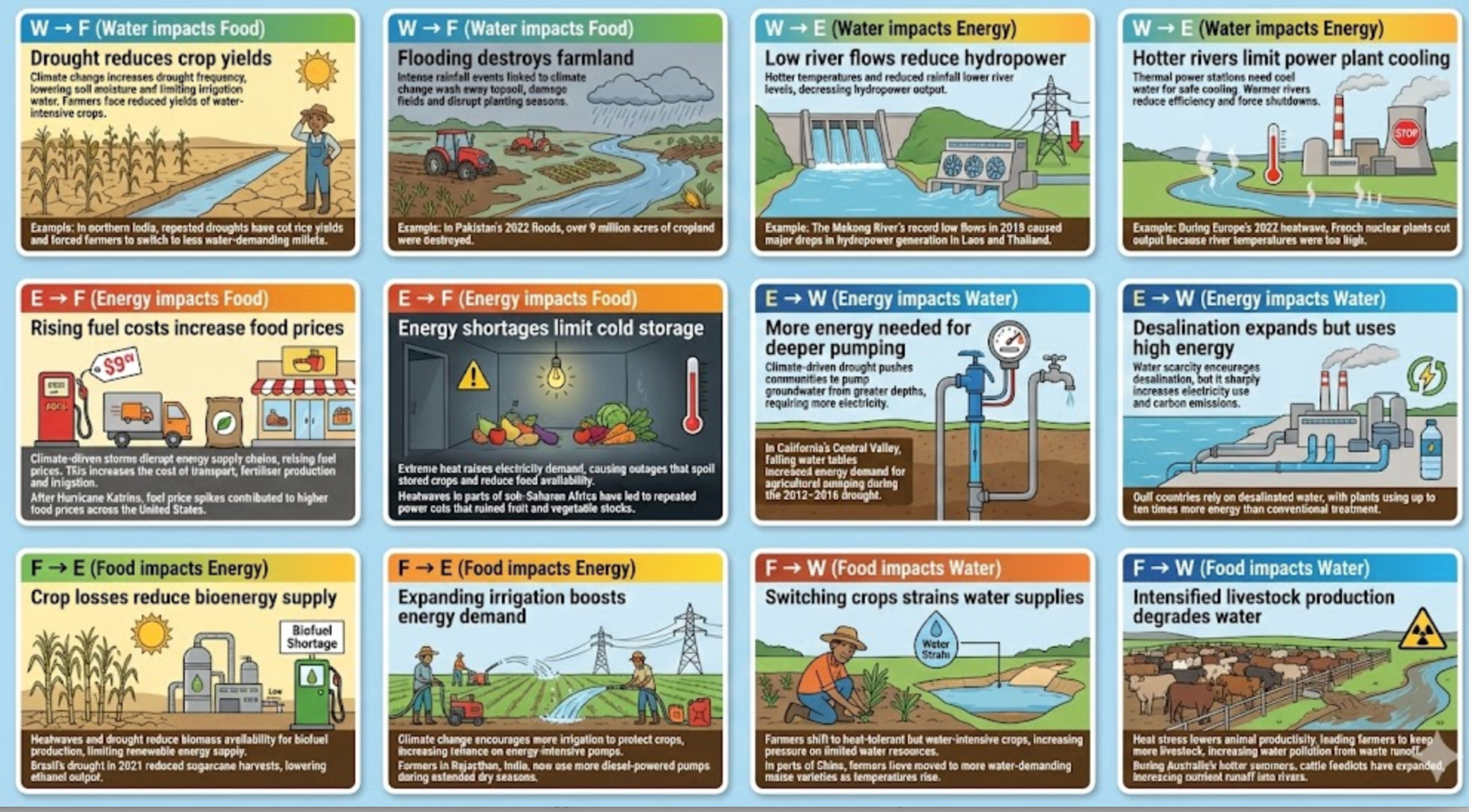
From One Shock to a Cascade: Climate Change and the Nexus
How environmental change intensifies pressure on water, food and energy security.
Climate change is a risk multiplier. Drought, flood and heat can alter yields, electricity generation, cooling demand, groundwater pumping, storage and food prices at the same time.
Build a climate cascade
- Select four cards that form a defensible cause-and-effect chain; add one missing connector if needed.
- Identify the starting hazard and add one named-place example.
- Identify who gains, loses or becomes more vulnerable at each stage.
- Swap with another group, challenge one weak link, then improve the chain with evidence.
Adaptation trade-off
- Choose desalination, deeper groundwater pumping, expanded irrigation, hydropower or biofuels.
- Explain how it improves one form of security but may weaken another. Judge it: solution, trade-off or maladaptation?
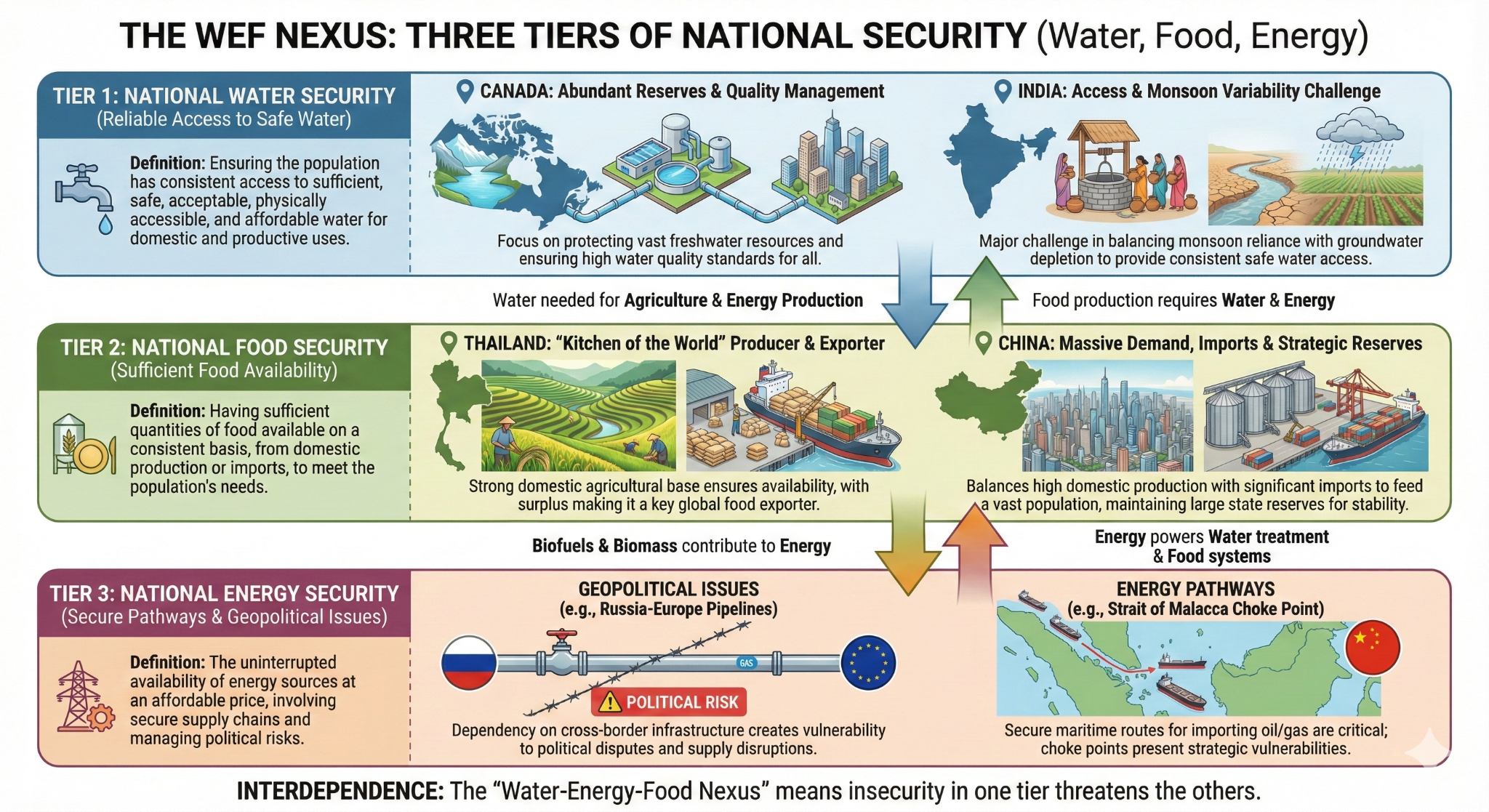
Security at Different Scales: Compare Places
Detailed examples showing how water, food and energy security vary between and within countries.
Canada, India, Thailand and China show why security cannot be predicted from income or national resource totals alone. Governance, climate, infrastructure, imports, reserves and geopolitical routes alter vulnerability.
Four-country security audit
- Assign each group one country. Record one strength, vulnerability and dependency for water, food and energy.
- Verify two claims with a reliable current source and check whether national data hide inequality.
- Re-form into mixed groups and rank resilience to drought plus an energy-price spike.
- Defend the ranking, then explain why another group might reasonably disagree.
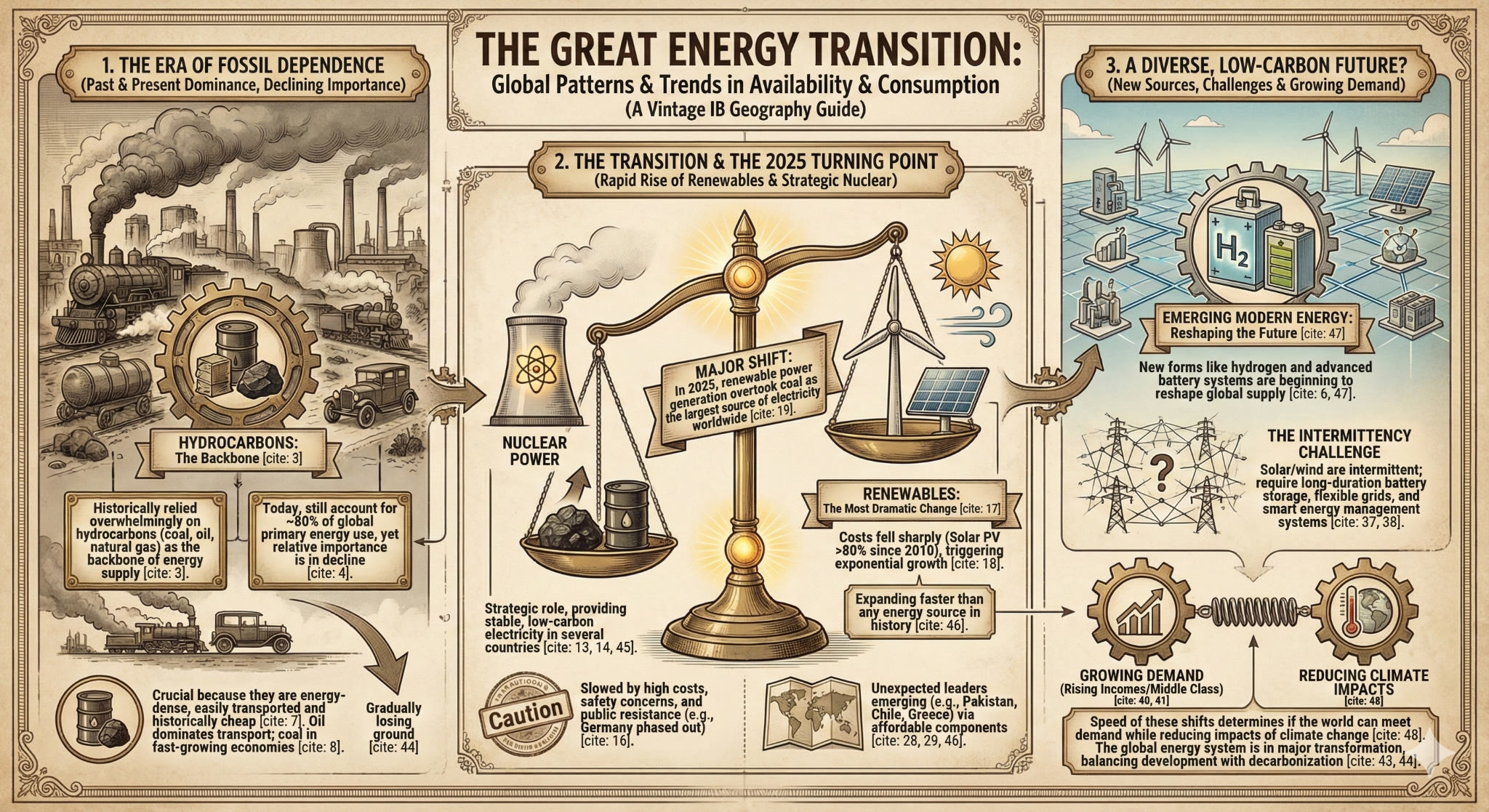
Changing Energy Sources: Transition, Security and New Trade-offs
The changing importance of energy sources and consequences for availability, consumption and security.
The transition is not a simple replacement of fossil fuels. Renewables, nuclear, storage, grids and emerging fuels develop at different rates while total demand rises. Distinguish electricity generation from total primary energy use.
Energy transition evidence check
- Sort the visual into continuing fossil dependence, evidence of transition and unresolved constraints.
- Verify three numerical or predictive claims using current IEA, IRENA or Ember data.
- Explain why renewable electricity growth does not mean fossil fuels are already unimportant.
- Evaluate: ‘The transition improves climate security but creates new mineral, grid and geopolitical insecurities.’
Your Trash’s Global Journey
The international flow, disposal and recycling of consumer waste and the spatial transfer of impacts.
A product may be designed in one country, consumed in another, sorted or exported through another, and repaired, recycled, burned or dumped elsewhere. These flows recover materials but can transfer health and environmental costs to people with less power.
Watch, map, question
- Build a flow map: consumption, collection, sorting, transport and final destination.
- At each stage record a stakeholder, decision and cost or benefit.
- Use different colours for material, money and environmental flows.
- Identify the intervention point with greatest potential and justify it.
Paired waste-connections role play
- Download the role cards. Pair each thrower with the person or place affected.
- Read both perspectives and identify the connection, power imbalance and environmental injustice.
- Negotiate shared responsibilities for consumers, firms and governments.
- Debrief: who benefits, who carries the costs, and how does uneven development shape the outcome?
Watch: Your Trash’s Global Journey
E-waste, Representation and Agbogbloshie
A place-based example of international waste flows, informal recycling and contested representations.
Agbogbloshie is often reduced to a toxic foreign dumping ground. The fuller geography includes imported used equipment, locally generated e-waste, repair, reuse, informal livelihoods, hazardous recovery and contested redevelopment.
- Separate imported used electronics, illegal waste shipments and domestically generated e-waste.
- Recognise severe risks alongside skills, livelihoods and material recovery.
- Evaluate images, documentaries and headlines as representations rather than neutral evidence.
Representation enquiry
- Write three words you associate with Agbogbloshie before watching; revise them afterwards.
- Compare the TED perspective with E-waste Republic: what does each foreground and omit?
- Write a balanced paragraph: claim, precise evidence, counter-perspective, judgement.
Watch: What a scrapyard in Ghana can teach us about innovation — DK Osseo-Asare
Synthesis & Exam Practice
Synthesis of consumption, security, interdependence, global flows and stakeholder responses.
Strong answers trace connections, use named-place evidence, recognise scale and stakeholder differences, and evaluate whether a response shifts insecurity elsewhere.
Systems conclusion
- Map links between middle-class consumption, the WEF nexus, climate change, energy transition and waste flows.
- Add two named places, three stakeholders, a feedback loop and an intervention point.
- Answer in 12 minutes: ‘Resource insecurity is caused more by unequal access and management than physical scarcity.’ Discuss.
- Self-check: definition, processes, precise examples, perspectives, counterargument and justified conclusion.