IB Geography • Section 3
Tourism & Sport at the International Scale
The varying power of different countries to participate in global tourism and sport
Restored from the original AdornGeo Weebly page • syllabus order preserved
Niche National Tourism Strategies
Niche national tourism strategies with a global sphere of influence, including adventure tourism, movie-location tourism and heritage tourism.
The original AdornGeo sequence contrasts specialised, small-market tourism with mass package tourism. It then moves through adventure and extreme-environment tourism, film locations and heritage tourism. The central geographical question is how a country turns a distinctive place, landscape or culture into a globally recognised destination without destroying the resource on which the strategy depends.
- Niche tourism targets a specialised interest and usually attracts fewer visitors than mass tourism, often with higher spending per visitor.
- Adventure and extreme-environment tourism use remoteness, risk and physical challenge as part of the attraction; Everest, Antarctica, the Sahara and Machu Picchu are located examples.
- Movie-location tourism converts a screen image into visitor flows: New Zealand's Hobbiton and Northern Ireland's Game of Thrones locations are clear examples.
- Heritage tourism focuses on historic places, artefacts, architecture and living cultures, but may also commercialise or crowd the heritage being promoted.
- A niche strategy can spread income to local guides and small firms, yet high prices, risk, carbon emissions and external ownership can make benefits uneven.
Build a niche-tourism typology
- Watch the four recovered AdornGeo clips. For each, identify the attraction, target market, required accessibility and the main risk to place.
- Locate Everest, the Sahara, Hobbiton and Giza on a world map. Draw an annotated flow line from likely source regions and explain why each destination has a global sphere of influence.
- Compare niche and mass tourism using visitor numbers, spending, environmental pressure, local control and cultural impact.
- Choose one national strategy and write a supported judgement: To what extent is niche tourism more sustainable than mass tourism?
Watch: Adventure tourism and the growth of specialised travel
Watch: Extreme tourism in the Sahara
Watch: Movie-location tourism and the Hobbiton effect
Watch: Heritage tourism and historic places
Hobbiton, Matamata — New Zealand
The Lord of the Rings and The Hobbit transformed a farm near Matamata into an internationally recognised visitor attraction. The case shows how film, national branding, tour operators and repeat media exposure can extend the sphere of influence of a rural place.
- Separate the original primary resource — rural landscape — from the purpose-built set, tours, transport and hospitality services.
- Trace the multiplier effect through guides, accommodation, food, transport and wider New Zealand branding.
- Evaluate seasonality, congestion, authenticity and the danger of depending on one cultural image.
The Role of TNCs in Expanding International Tourism
The role of TNCs in expanding international tourism destinations, including the costs and benefits of TNC involvement for different stakeholders.
Tourism TNCs link destinations to global flows of capital, passengers, bookings and images. Airlines, hotel groups, tour operators, restaurant chains and online booking platforms supply the secondary resources that can open up a destination. The original lesson asks students to avoid a simple good-or-bad judgement and instead compare outcomes for tourists, residents, employees, governments and local competitors.
- TNCs invest in primary attractions and in secondary resources such as airports, airlines, hotels, restaurants, roads, water supply and digital booking systems.
- Investment can create jobs, tax revenue, skills, infrastructure, foreign exchange and international marketing.
- Leakage occurs when profits, imported supplies and payments leave the host economy; repatriation can sharply reduce the local multiplier effect.
- Land-price inflation, cultural conflict, environmental pressure and competition with local firms distribute costs unevenly.
- Stakeholder outcomes differ: a tourist may gain accessibility while a resident faces higher prices, and a government may gain tax revenue while losing bargaining power to a large company.
Follow the tourism value chain
- Draw a systems diagram connecting an international airline, hotel chain, booking platform, destination government, employees, residents and tourists.
- Use two colours to show money retained locally and money leaking from the destination. Add one strategy that could increase local retention at each stage.
- Create a stakeholder matrix for tourists, residents, employees, government and local competitors. Give each stakeholder two benefits, two costs and an overall judgement.
- Answer: Examine how TNCs can expand tourism potential in a developing country. [10]
International tourism investment in Thailand
Thailand combines globally recognised primary resources with extensive secondary infrastructure. International airlines, hotel groups, tour operators and booking platforms have helped widen access and market reach, while debates continue over leakage, low-paid work, congestion, land values and environmental pressure.
- Distinguish investment in access, accommodation, food, attractions and digital marketing.
- Compare the gains of central government and global firms with outcomes for informal workers, small businesses and residents.
- Explain why Bangkok, Phuket, Pattaya and Chiang Mai have different tourism products and stakeholder conflicts.
Tourism as a National Development Strategy
The costs and benefits of tourism as a national development strategy, including economic and social/cultural effects. Case study of one low-income country or small island developing state.
The original AdornGeo material uses small island developing states to test whether tourism can drive development. Tourism can generate jobs, foreign exchange, tax revenue, infrastructure and a multiplier effect, but dependence creates exposure to recessions, hazards, conflict and changing consumer demand. The Maldives presentation and Tunisia medical-tourism material give contrasting applications.
- Economic gains include direct and indirect employment, tax revenue, foreign exchange, infrastructure and demand for locally supplied goods and services.
- Economic costs include public expenditure, inflation, regional inequality, seasonal work, imported inputs and profit leakage.
- Social and cultural gains may include heritage conservation, improved services, new opportunities for women and wider cultural exchange.
- Costs may include cultural commodification, crowding, resentment, crime, displacement and the breakdown of locally valued practices.
- Environmental protection may be financed by tourism, but resorts also consume land, water and energy and create sewage, waste and habitat loss.
- A highly tourism-dependent state is vulnerable to external shocks; resilience depends on diversification, local ownership and environmental management.
Maldives development audit
- Study the recovered 16-slide Maldives presentation and locate the archipelago southwest of India and Sri Lanka.
- Build a three-column impact table: economic, social/cultural and environmental. Within each column separate benefits from costs and identify the affected stakeholder.
- Create a vulnerability chain for one external shock — sea-level rise, tsunami, recession or pandemic — from tourist arrivals to household income and government revenue.
- Evaluate three responses: environmental impact assessment, resort waste treatment, renewable energy and economic diversification.
- Write a balanced answer: To what extent can tourism be used as a development strategy in a small island developing state? [10]
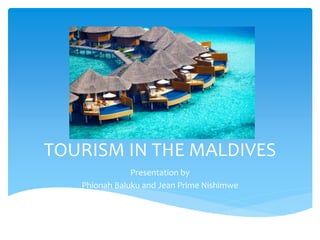
Watch: Tourism as a development strategy in a small island state
Watch: Economic, social and environmental impacts of tourism
Watch: Tourism in the Maldives
Medical tourism — Tunisia
Tunisia diversified beyond beach tourism by promoting spas, clinics, hospitals and treatment packages. The strategy created infrastructure and employment but also depended on European tour operators, exposed revenue to leakage and remained vulnerable to security shocks.
- Explain how natural therapeutic resources were combined with hospitals, clinics, hotels, airports and promotion.
- Use the Enfidha airport and spa development as evidence of secondary-resource investment.
- Evaluate dependence on European tour operators and the effect of the 2015 resort attack on demand.
Tourism dependence — the Maldives
The island-resort model earns foreign exchange and employment from tropical climate, beaches and reefs, but high import dependence and separation between resort islands and local communities can limit the multiplier effect. Sea-level rise, tsunami risk, recessions and tourism shocks expose the national economy.
- Link physical geography — low elevation, small islands and freshwater limits — to tourism vulnerability.
- Explain the resource footprint of resort water, energy, food and waste systems.
- Judge whether environmental rules and diversification reduce dependence sufficiently.
Hosting International Sporting Events
Political, economic and cultural factors affecting the hosting of international sporting events, including the costs and benefits for one country hosting an event.
Mega-events concentrate global flows of athletes, spectators, media, sponsorship and capital in a host city or country. The original sequence asks why some places can bid successfully, why others are excluded, and whether the long-term legacy justifies the cost. London 2012 and Beijing 2008 provide complementary case studies of regeneration, national image, infrastructure and uneven outcomes.
- Political stability, security, international relationships, government support and membership of sporting organisations affect eligibility and bid credibility.
- Economic capacity matters because venues, transport, accommodation, security and event operations require large up-front expenditure.
- Cultural interest, sporting history, public support and the ability to project a national image influence both bidding and attendance.
- Possible benefits include tourism, jobs, infrastructure, regeneration, civic pride, participation and soft power.
- Possible costs include debt, displacement, surveillance, congestion, environmental damage and underused 'white elephant' venues.
- Legacy must be evaluated over time and by stakeholder: an improved rail line may be a lasting public benefit while a specialised stadium becomes a maintenance burden.
London 2012 legacy enquiry
- Read the original London 2012 GeoFile on-page. Create a timeline from bid and construction to event and post-event legacy.
- Map Stratford and the Olympic Park in east London. Annotate transport, housing, venues, public space and the surrounding communities.
- Classify outcomes by economic, social, political and environmental dimension; then identify who gained, who paid and when each effect occurred.
- Compare London with Beijing using cost, infrastructure, image, displacement, venue reuse and participation legacy.
- Write a reasoned verdict: Evaluate the costs and benefits for one country hosting an international sporting event. [10]
Watch: London 2012 — pre-Games documentary
London Olympic Games — 2012
London used the Games to accelerate regeneration in Stratford and the Lower Lea Valley. Transport, parkland and housing formed part of the promised legacy, while construction and security costs, displacement, affordability and the uneven geography of benefits remain central to evaluation.
- Explain why London beat Paris in the final bid vote, including government backing, multicultural image, youth, sustainability and regeneration.
- Separate short-term event effects from long-term infrastructure and land-use change.
- Compare national image and tourism gains with local housing, employment and displacement outcomes.
Beijing Olympic Games — 2008
Beijing 2008 combined huge infrastructure investment with a deliberate attempt to project China's economic and political arrival. The spectacular event and transport improvements must be weighed against displacement, cost, environmental measures and the later use of specialised venues.
- Evaluate the Bird's Nest, Water Cube, transport and urban-image legacy.
- Identify the political and cultural messages communicated through the opening ceremony and built environment.
- Compare legacy planning and stakeholder outcomes with London 2012.