IB Geography • Section 1
Changing Leisure Patterns
How human development processes give rise to leisure activities
Restored from the original AdornGeo Weebly page • syllabus order preserved
Growth and Changing Purpose
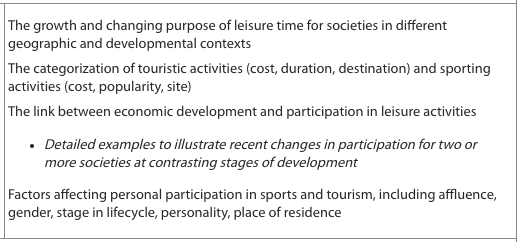
The growth and changing purpose of leisure time for societies in different geographic and developmental contexts.
Begin with the original AdornGeo leisure icons and syllabus overview. Students distinguish leisure, recreation, sport and tourism, then investigate how industrialisation, shorter working weeks, paid leave, rising incomes, transport and digital technology have changed both the amount and purpose of leisure.
- Leisure is time and activity freely chosen outside work and essential obligations; recreation is what people do in that time.
- The availability of leisure is uneven because time, disposable income, infrastructure and cultural expectations vary between places.
- Leisure has shifted from rest and recovery towards consumption, identity, health, social connection and experience.
Read the visual evidence
- Use the icon strip to classify ten activities as leisure, recreation, sport or tourism. Explain any overlaps.
- Compare how a teenager, working parent and retired person in two contrasting development contexts might allocate leisure time.
- After watching the two original videos, construct a timeline showing five changes in leisure and the process responsible for each change.
IB enquiry: who has leisure time?
- Choose two contrasting countries and locate comparable evidence for annual working hours, income and access to paid leave.
- Write a supported conclusion explaining why more income does not automatically produce more leisure time.

Watch: Leisure Time 3.0: what we really like to do
Watch: Traditional sport and changing leisure: the Highland Games
The Categorization of Tourism and Sport
The categorization of touristic activities (cost, duration, destination) and sporting activities (cost, popularity, site).
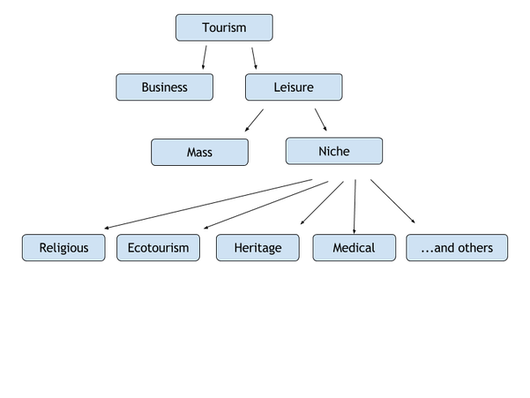
The original page moved from a broad tourism classification to examples of mass and niche travel. Students should recognise that categories overlap: a journey can be international, long-haul, high-cost, heritage-based and niche at the same time.
- Tourism can be classified by purpose, cost, duration, distance, destination, scale and organisation.
- Mass tourism uses high-volume standardised provision; niche tourism targets a specialised interest or market.
- Sport can be compared by cost of entry, participation, spectatorship, location, facilities and accessibility.
Build a classification matrix
- Read the original Types of Tourism handout embedded below.
- Place twelve tourism examples into a matrix using cost, duration and destination; add a second label for purpose.
- Create a parallel matrix for eight sports using cost, popularity and site, then explain two anomalies.
- Use the original classification diagram to evaluate whether mass and niche are opposites or points on a continuum.
Watch: MOVE: the motivations and experiences behind travel
Watch: Time Is Nothing: around the world in 343 days
Watch: Introduction to tourism
The Link with Economic Growth
The link between economic development and participation in leisure activities, with detailed examples of recent changes in participation for two or more societies at contrasting stages of development.
The original AdornGeo lesson used China to show how economic change, urbanisation, a growing middle class and transport investment transformed domestic and international tourism. Students compare this with a society at a contrasting stage of development rather than assuming that development affects every group equally.
- Rising disposable income expands the number, range and distance of leisure choices.
- Infrastructure, paid leave, passports, visas and social norms mediate the relationship between income and participation.
- National averages conceal inequalities by age, gender, class, ethnicity and place of residence.
China: from limited travel to a global tourism market
- Watch the three original China videos and identify evidence of changing participants, destinations and purposes.
- Read the original Asia-Pacific article and complete the embedded China case-study document.
- Create an annotated causal chain linking development to leisure participation. Include at least one political, social and infrastructural factor.
- Compare China with a lower-income society using the same indicators and write a balanced IB-style conclusion.
Watch: Older Chinese consumers spending on leisure
Watch: Holidaying the Chinese way: the middle class discovers tourism
Watch: How to be a Chinese tourist
The rapid growth of Chinese tourism
Economic growth created a large urban middle class with more disposable income, mobility and aspiration. The case study asks students to connect those changes to transport, government policy, demographic change and the geography of domestic and outbound tourism.
- Use located evidence and dates rather than describing China as a single uniform market.
- Separate growth in the number of tourists from growth in tourism spending.
- Evaluate who remains excluded from expanding leisure opportunities and why.
Factors Affecting Participation
Factors affecting personal participation in sports and tourism, including affluence, gender, stage in lifecycle, personality and place of residence.
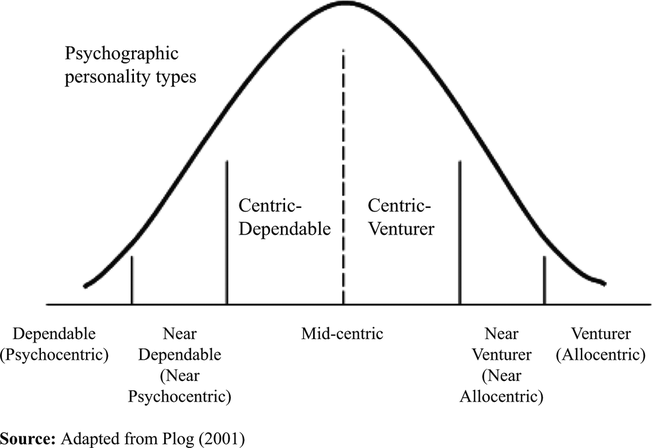
This final original lesson combines a sorting activity, a family lifecycle investigation and Plog's psychographic continuum. It shifts students from describing unequal participation to explaining how individual characteristics interact with social structures and geographical opportunity.
- Affluence affects affordability, but time poverty and unequal access may still restrict participation.
- Gender, age and lifecycle influence participation through caring roles, safety, health, norms and available time.
- Place of residence controls proximity to facilities, transport, landscapes and information.
- Plog's continuum models tourist personality from dependable/psychocentric to venturer/allocentric; it is a useful simplification, not a fixed label.
Participation sorting and lifecycle enquiry
- Complete the original tourism-growth sorting activity and group the factors as economic, social, demographic, technological, political or geographical.
- Use the family lifecycle activity to predict how leisure participation may change through five life stages.
- Place three contrasting tourist profiles on Plog's continuum and justify each position with evidence.
- Evaluate the statement: affluence is the most important influence on participation in sport and tourism.
Watch: Factors affecting global tourism
Watch: Why global tourism has boomed