IB Geography • Section 2.3
Responding to Global Climate Change
Possibilities for responding to climate change and power over the decision-making process
Restored from the original AdornGeo Weebly page • syllabus order preserved
Possibilities, Priorities and Power
Possibilities for responding to climate change and power over the decision-making process.
The original AdornGeo sequence begins with agency rather than inevitability. Students compare possible futures, distinguish individual and structural action, and ask who has the authority, finance and influence to choose a response.
- Mitigation reduces the causes of climate change; adaptation reduces harm from impacts; resilience supports recovery and continued functioning.
- Responses operate from households and communities to corporations, governments and international institutions.
- Power determines which risks receive attention, whose knowledge counts and who pays for action or loss.
- Effective response usually requires a portfolio of measures rather than one technological or behavioural solution.
Build a response spectrum
- Watch the three original opening films and list every proposed response.
- Classify each by scale, actor, mitigation or adaptation, and likely timescale.
- Use the original overview visual to connect responses to the climate system.
- Rank five actions using effectiveness, fairness, cost and feasibility, then defend the ranking.


Watch: Can We Fix Climate Change?
Watch: 2040: official trailer
Watch: Al Gore: the case for climate optimism
Disparities in Exposure and Vulnerability
Disparities in exposure to climate change risk and vulnerability, including variations in people's location, wealth, social differences (age, gender, education) and risk perception.
Climate hazard does not translate automatically into disaster. Exposure, sensitivity and adaptive capacity vary both between and within societies, creating strongly unequal outcomes.
- Location shapes exposure to heat, drought, floods, sea-level rise and changing ecosystems.
- Wealth influences housing, insurance, mobility, healthcare and the ability to invest before a hazard occurs.
- Age, gender, education, disability and employment can alter both exposure and access to assistance.
- Risk perception affects whether warnings are believed and whether individuals support costly action now for future benefit.
Map climate inequality
- Use the Carbon Map and Climate Risk Index to locate places with high exposure and low capacity to cope.
- Read the original heat-inequality PDF and identify the groups most at risk.
- Create a vulnerability profile for one Bangkok neighbourhood using location, wealth, age, education and risk perception.
- Explain why national averages can conceal vulnerability within a city or country.
Watch: Climate impacts, vulnerability and resilience
Watch: Climate change and the rich
Contrasting Vulnerability: Inuit, Haiti, Thailand and the USA
Detailed examples of two or more societies with contrasting vulnerability to climate change.
The original Weebly material deliberately compared several societies rather than reducing vulnerability to income alone. Environmental dependence, governance, infrastructure, social inequality and cultural ties to place all affect outcomes.
- For Inuit communities, warming affects sea ice, travel safety, food systems, housing and cultural continuity.
- Haiti combines intense hazard exposure with poverty, weak infrastructure and limited state capacity.
- Thailand faces coastal flooding, heat and agricultural risks, including changes to rice production and rural livelihoods.
- The USA has high aggregate wealth but unequal exposure, insurance, housing quality and political protection.
Construct a four-place comparison
- Use the three original films and linked readings to complete a comparison matrix.
- For each society, record exposure, vulnerable groups, capacity to adapt and one constraint on action.
- Select the strongest two-place contrast and explain why the same global process creates different local outcomes.
- Evaluate whether wealth is the most important determinant of climate vulnerability.
Watch: Climate change threatens the Inuit way of life
Watch: Climate change in Haiti
Watch: Climate change, migration and resilience in Thailand
From Arctic sea ice to Thai rice fields
Compare how physical exposure interacts with livelihoods, social difference and political capacity in Nunavut, Haiti, Thailand and the United States.
- Locate each example and identify the dominant climate hazards.
- Distinguish exposure from vulnerability and adaptive capacity.
- Use evidence at both national and community scales.
- Reach a judgement about the relative importance of wealth, governance and place dependence.
Government-led Adaptation and Mitigation
Government-led adaptation and mitigation strategies for global climate change.
Governments can regulate, tax, spend, plan infrastructure, coordinate disaster risk reduction and negotiate internationally. The original material asks students to distinguish the purpose and timescale of adaptation and mitigation before judging how they work together.
- Mitigation changes emissions or carbon sinks; adaptation changes exposure, sensitivity or capacity to cope.
- Some measures achieve both, such as urban trees that store carbon and reduce heat.
- Adaptation can be anticipatory or reactive, hard engineering or ecosystem-based, incremental or transformational.
- Maladaptation occurs when a response transfers risk to another group, place or future time.
Design a national response portfolio
- Use the original films and adaptation-mitigation diagram to build a two-column strategy bank.
- Choose a climate-vulnerable country and select three mitigation and three adaptation measures.
- Evaluate each using effectiveness, cost, timescale, equity and political feasibility.
- Identify one possible maladaptation and revise the proposal to reduce that risk.

Watch: An Inconvenient Sequel: Truth to Power
Watch: Adapting to a changing climate
Watch: Adaptation and mitigation
Watch: What is climate-change mitigation?
Watch: Five countries adapting to climate change
Global Geopolitical Efforts
Global geopolitical efforts, recognising that greenhouse-gas sources may be spatially distant from the countries most impacted.
Climate change is a global collective-action problem. Emissions mix in the atmosphere, while responsibility, benefit and impact are distributed unevenly across borders and generations.
- UN climate negotiations seek cooperation without a world government able to impose emissions cuts.
- Equity debates involve historical emissions, present emissions, capacity to pay and development needs.
- The Paris Agreement uses nationally determined contributions, transparency and repeated ambition cycles.
- Consumption and trade separate the location of demand from the location of production emissions.
Reconstruct a climate negotiation
- Use the original timeline, negotiation films and new climate-geopolitics presentation to identify major turning points and recurring causes of stalemate.
- Compare the live charts for atmospheric concentration and cumulative regional emissions.
- Represent two contrasting negotiating blocs: prepare their interests, evidence, power resources, red lines and one acceptable compromise.
- Run a short negotiation, record the final package, then evaluate whether the Paris model balances sovereignty, fairness and effective collective action.


Watch: A history of climate-change negotiations
Watch: Climate negotiations in 83 seconds
Watch: Introduction to global climate policy
Watch: A critique of the Paris Climate Agreement
Watch: Paris Agreement: Last Week Tonight
Watch: Make Our Planet Great Again
Costa Rica and decarbonisation
Costa Rica's long-term plan links electricity, transport, land use and economic development, providing a national-scale test of whether ambitious mitigation can also support development.
- Identify the sectors targeted for change.
- Distinguish existing strengths from future challenges.
- Evaluate transferability to a larger or more fossil-fuel-dependent economy.
Carbon Offsetting and Emissions Trading
Government-led adaptation and mitigation strategies, including carbon emissions offsetting and trading.
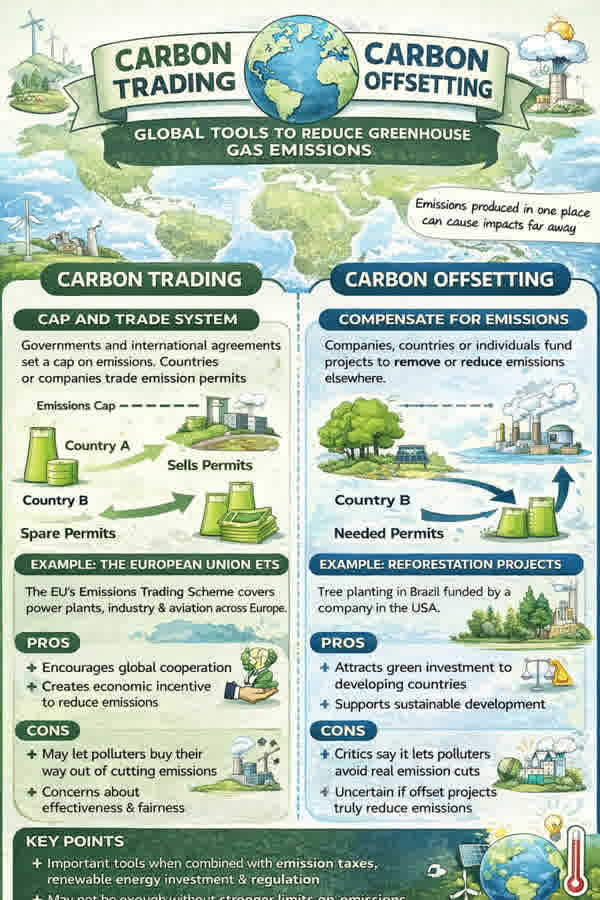
Market mechanisms put a price on emissions or fund reductions elsewhere. Students need to understand the mechanism before judging additionality, verification, leakage and fairness.
- Cap-and-trade limits total emissions and allows permits to be exchanged.
- Offsets claim to compensate for emissions by reducing or removing greenhouse gases elsewhere.
- A credible offset should be additional, measurable, durable and protected against double counting and leakage.
- Carbon pricing can be efficient, but design choices determine who pays and whether emissions genuinely fall.
Audit a carbon claim
- Use the new visual and original films to draw separate flow diagrams for cap-and-trade and carbon offsetting.
- Annotate each diagram with who sets the rules, where money moves, how emissions are counted and where failure could occur.
- Apply additionality, permanence, leakage and verification criteria to a real offset project.
- Compare a carbon tax, emissions-trading system and voluntary offset using effectiveness, equity, enforceability and risk of greenwashing.
- Reach a judgement on when market mechanisms support mitigation and when they delay direct reductions.
Watch: Carbon trading
Watch: How carbon offsetting works
Watch: Bhutan: the carbon-negative country
Technology and Geoengineering
Government-led strategies for global climate change, including technology such as geoengineering.
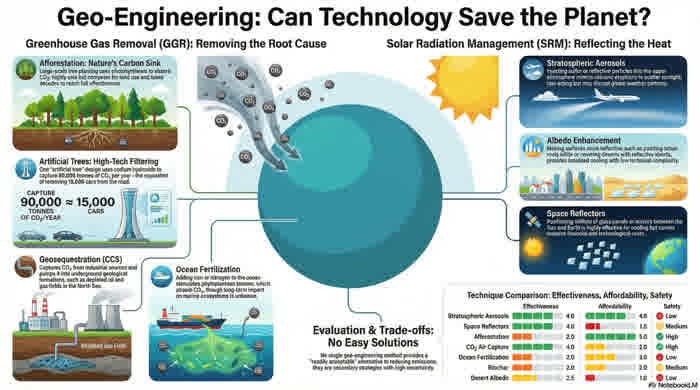
The archived AdornGeo lesson treats geoengineering as a decision problem rather than a miracle cure. Carbon-dioxide removal and solar-radiation modification differ in mechanism, speed, risk and governance.
- Carbon-dioxide removal addresses atmospheric concentration but may require extensive land, energy, finance and long-term storage.
- Solar-radiation modification could cool quickly but would not remove carbon dioxide or stop ocean acidification.
- Termination shock, uneven regional effects and cross-border impacts create major governance risks.
- Technical feasibility does not resolve ethical questions about consent, control, compensation and moral hazard.
Geoengineering decision conference
- Use the new infographic to classify each proposal as greenhouse-gas removal or solar-radiation modification, then explain the mechanism in one sentence.
- Treat the infographic's ratings as claims to test: compare them with the original diagrams and research evidence for effectiveness, cost, speed, reversibility and risk.
- Represent a vulnerable state, major emitter, scientist, company and civil-society group in a decision conference.
- Write a final recommendation that distinguishes research, small-scale trials and deployment, and names who should govern each stage.


Watch: The climate-change experiment
Watch: Solar geoengineering and global warming
Watch: Climate Solver: carbon removal
Watch: David Keith on geoengineering
Watch: What is climate-change mitigation?
Quizlet: Geoengineering terminology
Corporate Strategies: IKEA
Civil society and corporate strategies to address global climate change.
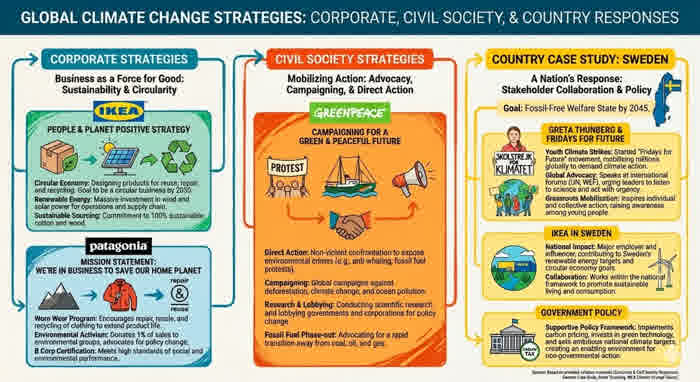
Companies influence operational emissions, product design, supply chains, investment and consumer behaviour. The original IKEA case asks whether corporate climate action transforms the business model or mainly improves its image.
- Corporate targets may cover direct operations, purchased energy and wider value-chain emissions.
- Supply-chain emissions often exceed those from offices and stores, making procurement and product design important.
- Absolute reductions should be distinguished from intensity targets and offset-based claims.
- Transparency, independent verification and treatment of consumption growth affect credibility.
Interrogate a corporate climate strategy
- Watch the original IKEA film and identify actions across stores, energy, products and supply chains.
- Use the embedded position paper to identify what IKEA asked governments to do.
- Test the strategy for absolute reduction, transparency, verification and dependence on offsets.
- Reach a reasoned judgement: transformation, useful incrementalism or greenwashing?
Watch: IKEA facts and figures: climate positive
Civil Society, Climate Justice and Public Pressure
Civil society strategies to address global climate change.
Civil society can change public narratives, mobilise participation, challenge governments and corporations, litigate, divest and demonstrate alternatives. The original sequence combines youth activism, nonviolent direct action and NGO campaigning.
- Civil society includes NGOs, community groups, social movements, faith groups, unions, schools and informal networks.
- Strategies range from education and consumer action to protest, litigation, lobbying, divestment and direct action.
- Climate justice connects responsibility and vulnerability with rights, recognition and fair distribution of costs.
- Campaign effectiveness can be judged through agenda setting, policy change, behaviour, participation and institutional response.
Evaluate a climate campaign
- Watch the new Corporate & Civil Climate Action video, then compare its corporate and NGO examples with the original Bastida, Thunberg, Disobedience and Greenpeace films.
- Identify each campaign's target, theory of change, tactics, audience and evidence of impact.
- Use the original climate-justice visual to connect responsibility, vulnerability and voice.
- Design an evidence-based NIST climate campaign with a measurable objective, chosen decision-maker, theory of change and evaluation plan.

Watch: Corporate and civil-society climate action
Watch: Imagine the Future with Xiye Bastida
Watch: Greta Thunberg: inspiring others to act
Watch: Disobedience
Watch: Greenpeace global-warming campaign
Watch: Climate change: human lives and justice
Watch: Greenpeace: stopping climate change
Country Case Study: Sweden and Non-governmental Action
Case study of the response to climate change in one country, focusing on the actions of non-governmental stakeholders.
The recovered country case study combines Sweden's national setting with youth-led school strikes. Students should keep the focus on non-governmental actors while examining how their action interacts with government policy and public culture.
- Sweden's low-carbon electricity, carbon tax and climate legislation shape the context in which civil society acts.
- Fridays for Future used a simple, reproducible tactic to turn individual protest into a transnational movement.
- Young activists exercise agenda-setting and discursive power even without formal voting or regulatory authority.
- Impact should be judged beyond media visibility, including policy attention, participation and long-term cultural change.
Build the Sweden case study
- Complete the original Sweden note sheet and establish the national climate-policy context.
- Use the new multi-actor visual and three original strike films to trace movement diffusion from one protest to global action.
- Map the formal and informal power resources available to students, NGOs, companies and government, and draw the connections between them.
- Evaluate the effectiveness of non-governmental stakeholders using at least three criteria and a counterargument.
Watch: Greta Thunberg: I want you to panic
Watch: The case to act now on climate change
Watch: Students around the world join the climate strike
Sweden: youth activism and climate governance
Sweden provides a located case study of how non-governmental stakeholders can shape debate and action within a supportive but contested national policy context.
- Locate Sweden and establish its energy, emissions and policy context.
- Trace the origins and diffusion of Fridays for Future.
- Distinguish formal government power from the agenda-setting power of civil society.
- Evaluate achievements, limitations and evidence of lasting change.
Synthesis: Practicality, Urgency and Competing Viewpoints
Synthesis, evaluation and skills: why perspectives differ about the need for, practicality and urgency of action on global climate change.
A strong IB evaluation recognises that disagreement is not only about climate science. Values, interests, identity, discounting of future costs, trust, political ideology and perceptions of fairness shape preferred responses.
- Actors disagree about acceptable risk, who should pay and how present costs should be weighed against future losses.
- A response can be technically possible yet politically difficult or socially unjust.
- Urgency may favour rapid action, while legitimacy and fairness may require deliberation and participation.
- Evaluation should compare mitigation, adaptation and resilience across scales rather than searching for a single best answer.
IB evaluation workshop
- Place government, corporate and civil-society strategies on an effectiveness-fairness matrix.
- Add evidence from Costa Rica, IKEA, Sweden, carbon markets and geoengineering.
- Write a thesis for: 'Governments have more power than any other actor to address global climate change.'
- Plan an evaluation of the claim that urgent action is more important than equitable action.